

Key facts at a glance
- Typical sizes: 5 to 20 kilowatts (kW)
- Where they're common: Texas and Florida homes with heat pumps or electric air handlers
- Typical lifespan: often 10 to 15+ years with regular maintenance
- Other names: heat kit, electric heat strip, auxiliary heat, backup heat, electric resistance heat
In this guide
- How do heat strips work?
- Aux heat vs. emergency heat: what your thermostat means
- Are heat strips expensive to run?
- Do you need heat strips in Texas and Florida?
- What size heat strip do you need?
- Signs your heat strips aren't working
- Why do heat strips smell like burning, and are they safe?
- Heat strips vs. a gas furnace
- How long do heat strips last?
- Frequently asked questions
(Web team: make each item a jump link to its H2 so Google can show sitelinks.)
How Do Heat Strips Work?
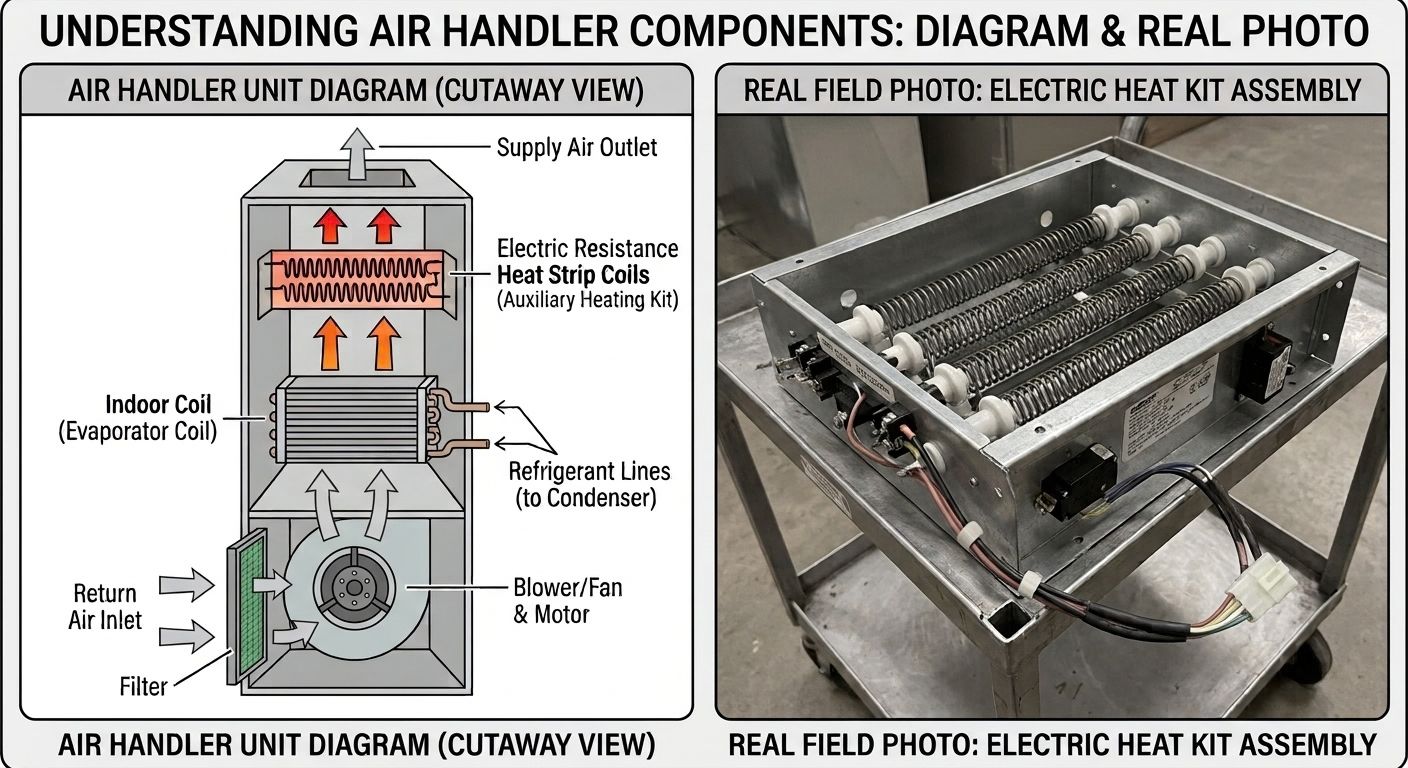
When your thermostat calls for more heat than the heat pump can supply, electricity flows through nickel-chrome coils in the air handler. The coils glow hot, and your blower pushes air across them and into your ducts. It's the same idea as a toaster or a space heater, just built into your HVAC system.
Here's what happens, step by step:
- The thermostat senses a big gap. The indoor temperature is well below your setting, or the heat pump alone isn't closing the gap fast enough.
- It signals the air handler. The thermostat sends a call for auxiliary (second-stage) heat.
- A sequencer turns the strips on in stages. Larger heat kits switch on one element at a time so they don't overload your electrical circuit all at once.
- Safety devices stand guard. Limit switches and thermal fuses cut power to the coils if they get too hot, for example when airflow is blocked by a dirty filter.
Heat strips vs. heat pump: what's the difference?
A heat pump doesn't create heat. It moves heat from the outdoor air into your home using refrigerant, which is why it's so efficient. Heat strips create heat directly from electricity. That makes them reliable in any weather, but they use roughly two to three times more electricity for the same amount of heat.
Why your heat pump needs backup heat
Heat strips usually turn on in three situations:
- Very cold weather. As outdoor temperatures drop toward freezing, a heat pump's output falls. The point where it can no longer keep up on its own is called the balance point, often somewhere around 30–40°F depending on the system and the home.
- Defrost cycles. In cold, damp weather, frost builds on the outdoor coil. The heat pump briefly reverses to melt it, and heat strips warm the air so cold air doesn't blow from your vents.
- Big thermostat jumps. Raising the setting several degrees at once can trigger the strips to speed up recovery.
Aux Heat vs. Emergency Heat: What Your Thermostat Means
Aux heat means your heat pump and heat strips are working together, and it's normal on cold mornings. Emergency heat means the heat pump is off and only the heat strips are running, which you should use only if the heat pump is broken or damaged.
Aux heat | Emergency heat | |
|---|---|---|
How it turns on | Automatically | Manually, by you |
Is the heat pump running? | Yes | No |
Cost to run | Higher | Highest |
When it's normal | Cold mornings, defrost cycles, big setpoint jumps | Only when the heat pump fails, ices over or is damaged |
Thermostat label | AUX HEAT, AUX, or 2nd stage | EM HEAT or EMERG |
My thermostat says aux heat. What does that mean?
It means your system has added heat strips to help the heat pump. On a cold morning or during a defrost cycle, that's expected and nothing is wrong. The light should turn off on its own once your home reaches the set temperature.
Is it bad if aux heat is on all the time?
Short bursts are normal; nonstop aux heat in mild weather is not. If outdoor temperatures are above about 40°F and aux heat runs for hours, something may be keeping the heat pump from doing its job. Common causes include:
- Low refrigerant or a refrigerant leak
- A failing outdoor unit, compressor or reversing valve
- An outdoor coil stuck in ice
- A thermostat that's wired, set up or programmed incorrectly
- A very dirty air filter or blocked return vents
Should I turn on emergency heat when it's freezing outside?
Usually no. Your system already switches to aux heat automatically when it needs help. Turning on emergency heat shuts the heat pump off completely, so you lose its efficiency and pay more. Save emergency heat for when the outdoor unit is broken, iced over or damaged, and have it checked soon.
Are Heat Strips Expensive to Run?
Yes, heat strips are the most expensive part of a heat pump system to run. To estimate the cost, multiply the strip size in kilowatts by your electric rate. A 10 kW strip at about 15¢ per kWh costs roughly $1.50 for every hour it runs at full power.
Estimated cost per hour of run time (at about 15¢ per kWh; check your bill for your actual rate):
Heat strip size | Estimated cost per hour |
|---|---|
5 kW | about $0.75 |
8 kW | about $1.20 |
10 kW | about $1.50 |
15 kW | about $2.25 |
20 kW | about $3.00 |
These are estimates. Strips cycle on and off and often run in stages, so your real daily cost depends on the weather, your home's insulation and your thermostat settings.
Why did my electric bill double after a freeze?
During a hard freeze, your heat pump can't keep up on its own, so the heat strips run for long stretches. Because strips use two to three times more electricity than the heat pump for the same heat, a few cold days can push a winter bill far higher than normal. If your bill jumps when the weather is mild, that's a sign aux heat is running when it shouldn't.
5 ways to lower your heat strip costs
- Avoid big thermostat jumps. Raise the temperature 1–2 degrees at a time instead of 5 or more.
- Use a smart thermostat with an aux heat lockout. It can block heat strips above a set outdoor temperature, so the heat pump does the work when it can.
- Change your air filter often in winter. A clogged filter cuts airflow, which makes the system work harder and can trip safety switches.
- Get a fall maintenance check. A technician can confirm refrigerant levels, defrost controls and thermostat settings before heating season.
- Seal duct leaks and add insulation. Warm air lost in the attic means more run time for the strips.
Do You Need Heat Strips in Texas and Florida?
If you have a heat pump in Texas or Florida, you almost certainly want heat strips. Winters in both states are mostly mild, but the few hard cold snaps each year are exactly when a heat pump struggles and your family needs heat the most.
Heat strips in Texas (Dallas–Fort Worth, Austin, Houston, San Antonio)
Most Texas winter days are well within a heat pump's comfort zone. The risk is the occasional hard freeze. During the February 2021 winter storm, temperatures across the state dropped into the single digits and teens, far below what most heat pumps can handle alone. In weather like that, heat strips are your safety net.
North Texas, including Dallas, Fort Worth and Arlington, sees more freezing nights than Houston or San Antonio, so strips tend to run more there.
Heat strips in Florida (Orlando, Tampa)
Many Central Florida homes have an air handler with heat strips as their main or only heat source, often paired with a straight AC rather than a heat pump. Because cold snaps are short and infrequent, a full furnace rarely makes sense. If your home is set up this way, the heat strips are doing all the heating, which is normal.
One Florida tip: strips may sit unused for 10 or 11 months. Dust settles on the coils, which is why the first cold morning often brings a brief burning-dust smell (more on that below).
Are heat strips necessary everywhere?
Not always. Some newer cold-climate heat pumps keep working well into low temperatures, and homes with gas furnaces in a dual-fuel setup use gas as backup instead. But for a standard heat pump in Texas or Florida, heat strips are the usual and practical backup.
What Size Heat Strip Do You Need?
Most homes need a heat strip between 5 and 15 kW, matched to the size of the heat pump and the home's heat loss. The final size should come from a proper load calculation (often called a Manual J), not a rule of thumb.
Approximate sizing guide:
Heat pump size | Common heat strip size |
|---|---|
1.5–2 ton | 5 kW |
2.5–3 ton | 8–10 kW |
3.5–4 ton | 10–15 kW |
5 ton | 15–20 kW |
What decides the right size?
- Your home's heat loss: square footage, insulation, windows and air leaks
- Your climate: North Texas needs more backup capacity than Tampa
- Your air handler: each model lists the heat kits it's approved to use
- Your electrical panel: larger strips need larger breakers and wiring
Is bigger better?
No. An oversized heat strip doesn't make your home much more comfortable, but it can raise your bills and put extra load on your electrical panel. An undersized strip, on the other hand, may leave you cold during a hard freeze. The goal is enough backup for your coldest likely days, and no more.
Signs Your Heat Strips Aren't Working
The clearest sign of bad heat strips is cool or lukewarm air from your vents on a cold day while the thermostat shows aux heat. Other warning signs include a tripping breaker, a burning smell that won't go away, and an electric bill that spikes for no clear reason.
Watch for these symptoms:
- Air from the vents feels cool or lukewarm on cold days
- "AUX HEAT" shows on the thermostat, but the house won't warm up
- The heat strip breaker keeps tripping
- A burning smell that lasts more than a few minutes
- Your electric bill jumps with no change in the weather
- Heat works on mild days but falls behind as soon as it gets cold
Why is my heat pump blowing cold air in winter?
A short blast of cool air during a defrost cycle can be normal. Steady cold air usually points to one of two problems: the heat pump isn't heating (refrigerant, compressor or reversing valve issue), or the heat strips aren't kicking in to help (a burned-out element, a failed sequencer or relay, or a tripped limit switch).
Why does my heat strip breaker keep tripping?
A breaker that trips again and again is a safety warning, not a nuisance. It can mean a shorted element, loose or damaged wiring, a failing breaker, or a heat kit that's too large for its circuit. Don't keep resetting it; leave it off and have the system inspected.
How to check your heat strips safely
These three steps are safe for any homeowner. (Web team: mark this section up with HowTo schema.)
- Check the thermostat. Make sure it's set to Heat, not Cool or Off, and that the set temperature is a few degrees above room temperature.
- Check the breaker. In your electrical panel, find the breaker labeled for the air handler or heat strips. If it's tripped, reset it once. If it trips again, leave it off.
- Test emergency heat briefly. Switch the thermostat to emergency heat for 10–15 minutes and feel the air at a vent. Warm air means the strips are working; cool air means they likely aren't. Switch back to normal heat afterward.
Stop here. Heat strips run on high-voltage power, often 240 volts. Anything inside the air handler, including elements, sequencers, relays and limit switches, should be checked only by a licensed HVAC technician.
Why Do Heat Strips Smell Like Burning, and Are They Safe?
A light burning-dust smell the first few times you turn on the heat each season is normal; dust on the coils is burning off. A smell that lasts more than 30 minutes, smells like melting plastic or electrical wiring, or comes with smoke is not normal and needs attention right away.
Smell | Likely cause | What to do |
|---|---|---|
Dusty, faint burning, fades in under 30 minutes | Dust burning off the coils after months unused | Normal; replace the air filter if it's dirty |
Burning dust that returns every time | Very dirty filter or dust buildup in the air handler | Replace the filter; schedule a cleaning |
Melting plastic or hot wiring | Overheating wire, connector or component | Turn the system off at the thermostat and the breaker; call a technician |
Any smell with smoke or sparks | Electrical fault | Turn off power, leave the area if needed, and call 911 if there's fire |
Can heat strips cause a fire?
It's rare when the system is installed and maintained correctly. Heat strips have limit switches and thermal fuses that cut power if the coils overheat. The risk goes up with clogged filters, failed safety switches, loose wiring or the wrong breaker size, which is why a yearly inspection matters.
Is it safe to leave heat strips on overnight?
Yes. Heat strips are designed to cycle on and off automatically as your thermostat calls for heat, day or night. You don't need to turn them off at bedtime. Just keep the filter clean and the area around the air handler clear of stored items.
Heat Strips vs. a Gas Furnace
Neither is best for every home. Heat strips cost less to install and need no gas line, but they cost more per hour to run. In mild Texas and Florida winters, a heat pump with heat strips is often the most practical choice, while gas or dual-fuel can make sense for homes that already have gas service.
Heat pump + heat strips | Gas furnace | Dual fuel (heat pump + gas furnace) | |
|---|---|---|---|
Upfront cost | Lower | Moderate | Highest |
Cost to run in mild weather | Low (heat pump does most of the work) | Moderate | Low |
Cost to run in hard freezes | High (strips run longer) | Moderate | Moderate |
Needs a gas line? | No | Yes | Yes |
Safety notes | No combustion, no carbon monoxide | Needs venting and a CO detector | Needs venting and a CO detector |
Best fit | Most Texas and Florida homes | Colder areas, homes with gas | Homes with gas that want low bills in freezes |
When you compare heat pumps, look at the HSPF2 rating for heating efficiency and SEER2 for cooling efficiency. Higher numbers mean lower bills, and a more efficient heat pump leans on the heat strips less often.
How Long Do Heat Strips Last?
Heat strips often last 10 to 15 years or more, and many outlast the heat pump they're paired with. When they do fail, it's usually one part rather than the whole heat kit, so a single repair often brings them back.
Common heat strip failures
- Burned-out element: one coil breaks, so you get less heat
- Bad sequencer or relay: the switch that turns the strips on fails
- Tripped or failed limit switch: often caused by poor airflow from a dirty filter
- Blown thermal fuse: a one-time safety fuse that opens after overheating
- Loose or burned wiring: connections loosen over years of heating and cooling
Simple ways to help them last
- Replace or clean the air filter every 1–3 months, and monthly during heavy use
- Keep supply and return vents open and unblocked
- Have the system checked each fall, before the first cold snap
- Don't keep resetting a breaker that trips; find the cause
Frequently Asked Questions About Heat Strips
What are heat strips in an HVAC system?
Heat strips are electric resistance coils installed in your air handler. They act as backup heat for a heat pump, turning on when it's too cold outside for the heat pump to keep up, during defrost cycles, or when you raise the thermostat a lot at once.
Is it normal for aux heat to come on?
Yes. Aux heat often runs on cold mornings, during defrost cycles, or after you raise the thermostat several degrees. It's a concern only if it runs nearly all the time in mild weather, which can point to low refrigerant, a failing heat pump or a thermostat problem.
What is the difference between aux heat and emergency heat?
Aux heat turns on automatically and runs the heat strips alongside your heat pump. Emergency heat is a setting you choose that turns the heat pump off and runs only the heat strips. Use emergency heat only when the heat pump is broken, because it's the most expensive way to heat.
How much does it cost to run heat strips?
Multiply the strip size in kilowatts by your electric rate. A 10 kW strip at about 15 cents per kWh costs roughly $1.50 for each hour it runs. Strips cycle on and off, so real daily cost depends on weather and thermostat settings.
Why do my heat strips smell like burning?
A light burning-dust smell the first few times you turn on the heat each season is normal; dust on the coils is burning off. If the smell lasts more than 30 minutes, smells like melting plastic, or comes with smoke, turn the system off at the thermostat and call a technician.
Can heat strips cause a fire?
It's rare when the system is installed and maintained correctly. Heat strips have limit switches and fuses that cut power if they overheat. Risk rises with clogged filters, failed safety switches, loose wiring or the wrong breaker size, which is why yearly inspections matter.
How long do heat strips last?
Heat strips often last 10 to 15 years or more. Common failures are burned-out elements, bad sequencers or relays, and tripped limit switches. Many of these can be repaired without replacing the whole heat kit.
Do I need heat strips in Texas?
If you have a heat pump, yes in most cases. Texas winters are mostly mild, but hard freezes push heat pumps beyond their limits. Heat strips keep your home warm during those cold snaps, when you need heat the most.
Do homes in Florida use heat strips?
Yes. Many Orlando and Tampa homes have an air handler with heat strips as their main or only heat source, since cold weather is short and infrequent. A yearly check keeps them ready for the first cold snap.
Are heat strips better than a gas furnace?
Neither is best for every home. Heat strips cost less to install and need no gas line, but cost more per hour to run. In Texas and Florida's mild climates, a heat pump with heat strips is often the most practical choice.
The Bottom Line on Heat Strips
Heat strips are your heat pump's electric backup: simple, reliable and built for the few cold days a heat pump can't handle alone. Seeing "AUX HEAT" on a cold morning is normal. Nonstop aux heat in mild weather, cold air from the vents, a tripping breaker or a lasting burning smell are signs to have the system checked.