
How Often Should You Have Your Air Conditioner Serviced?
How often your AC actually needs servicing, and what skipping it costs you in efficiency, energy bills and early breakdowns.
March 22, 2025

What's Changed, What It Costs, and What Every DFW Homeowner Needs to Know Right Now
Neglecting AC maintenance leads to a gradual decline in performance, higher energy bills, and breakdowns that always seem to happen on the hottest day of the year. But how often should you really service it, and what's changed in 2025 and 2026 that every homeowner needs to know? This guide covers everything, from costs and checklists to the new refrigerant regulations, the expiration of federal tax credits, and what smart homeowners are doing differently in 2026.
What's In This Guide
- How often should you have your AC serviced?
- How much does AC service cost in 2026?
- What does a full AC tune-up include? (Complete checklist)
- Signs your AC needs a tune-up right now
- Benefits of regular AC maintenance
- When is the best time to schedule service?
- The 2025 refrigerant phaseout — what it means for your wallet in 2026
- Federal HVAC tax credits: they expired in 2025 — here's what's still available
- Should I repair or replace my AC unit?
- DIY maintenance tips between professional visits
- Smart thermostats and Wi-Fi integration: the 2026 upgrade worth making
- How to choose the right HVAC contractor
How Often Should You Have Your AC Serviced?
The standard recommendation from HVAC professionals and manufacturers is once per year, scheduled in early-to-mid spring before the summer heat arrives. However, several factors can shift that recommendation.
Household Type | Recommended Frequency |
|---|---|
Average home, system under 10 years old | Once a year (spring) |
Home with pets or heavy allergy sufferers | Twice a year (spring + fall) |
System older than 10 years | Twice a year |
Extremely dusty environment (near construction, rural fields) | Twice a year |
Vacation home / rarely used system | Once a year minimum |
ADU, garage conversion, or addition with ductless mini-split | Once a year per indoor unit |
Commercial or large residential system | Quarterly inspection + annual full service |
An unserviced AC loses approximately 5% efficiency per year. Over five years, that translates to 25% more energy consumed, and a bill that keeps climbing every summer.
Pro Tip: Always check your manufacturer's warranty. Many require documented annual professional service to keep the warranty valid. Skipping even one year can void your coverage.
How Much Does AC Service Cost in 2026?
One of the most searched questions is "how much does an AC tune-up cost?" Here's what you can realistically expect to pay in 2026:
Service Level | What's Included | Typical Cost |
|---|---|---|
Basic Tune-Up | Filter change, basic inspection, thermostat check, debris clearing | $80 – $160 |
Standard Service | Everything in Basic + coil cleaning, drain line flush, refrigerant level check, electrical connections | $160 – $270 |
Premium / Comprehensive | Full diagnostics on every component, worn-part replacement, air quality testing, efficiency report | $270 – $575 |
Annual Maintenance Plan | 2 visits/year, priority scheduling, repair discounts (10–15%) | $160 – $500/year |
Additional costs to be aware of in 2026:
- Refrigerant recharge (R-410A): $200 – $450+ per recharge. Costs have risen significantly as supply tightens following the 2025 phaseout. In some markets, R-410A prices increased 300% between 2021 and 2025. If your system regularly needs a recharge, this is a serious cost to factor into your repair-vs-replace decision.
- Refrigerant recharge (R-454B / new systems): $150 – $350. Costs for the new refrigerant are stabilizing as supply chains catch up.
- Refrigerant leak detection: $100 – $330 to locate; $200 – $1,500 to repair depending on severity.
- Capacitor replacement: $100 – $250, one of the most common repairs.
- Fan motor replacement: $200 – $700.
- Duct cleaning (if needed): $250 – $500, a separate service from the standard tune-up.
Money-saving tip: Book your AC service in early spring or late winter. Peak summer demand can push prices up significantly, and technician availability drops fast. Many companies also offer pre-season discounts.
What Does an AC Tune-Up Include? (Full Checklist)
Many homeowners wonder what a technician actually does during an AC service visit. Here is a full checklist of what a thorough, professional tune-up should cover:
Electrical & Controls
- Inspect and tighten all electrical connections
- Test and calibrate the thermostat (including smart thermostat sync if applicable)
- Check capacitors and contactors
- Test start and run components
- Verify safety controls and shutoffs
- On new R-454B systems: verify refrigerant leak detection sensors are functioning
Refrigerant & Coils
- Check refrigerant levels (low refrigerant = major efficiency loss)
- Inspect for refrigerant leaks
- Verify refrigerant type matches system specification (critical in 2026 — R-410A and R-454B are NOT interchangeable)
- Clean evaporator coil (indoor)
- Clean condenser coil (outdoor)
Airflow & Filtration
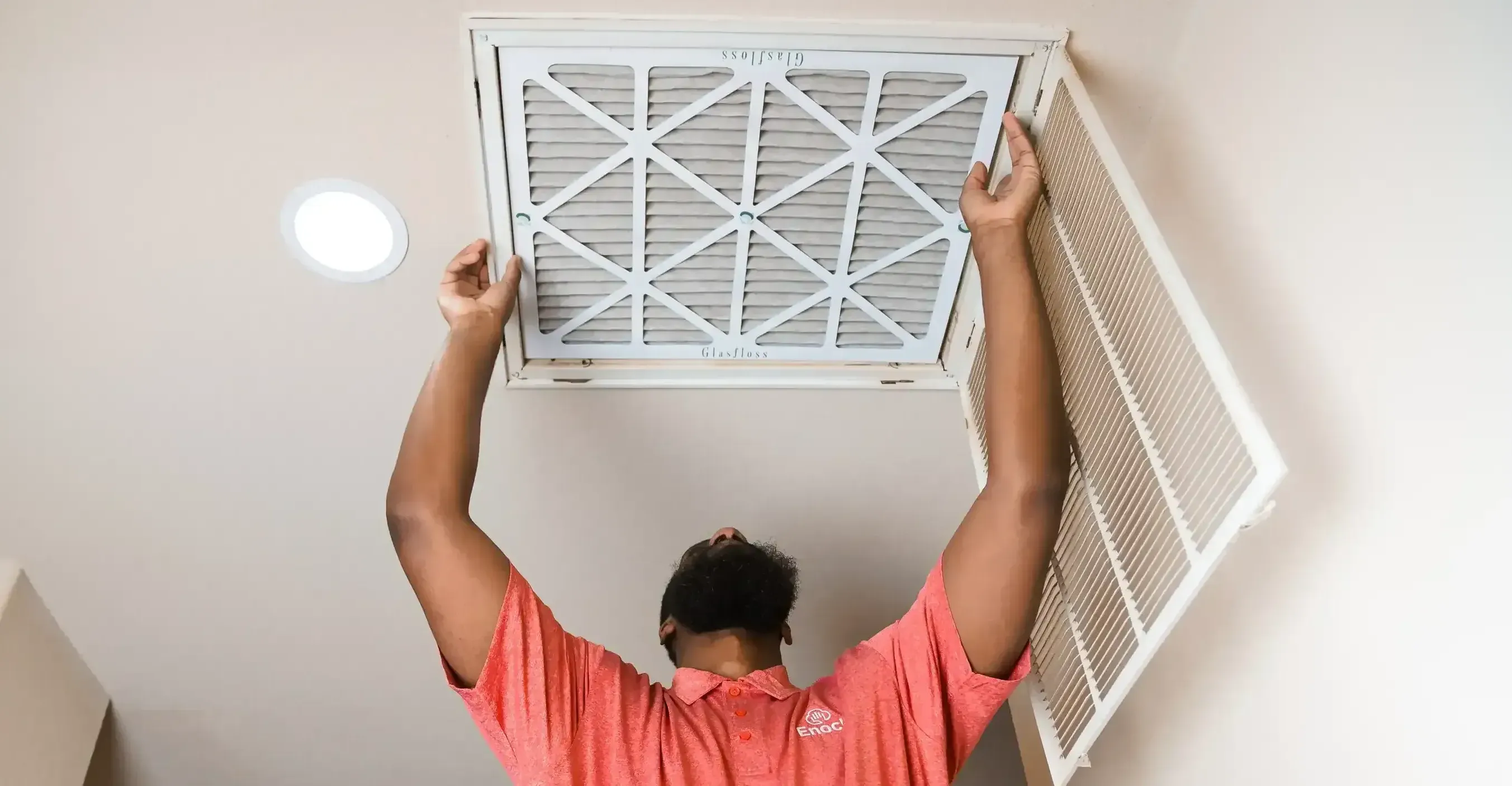
- Replace or clean air filter
- Inspect and clear condensate drain line (prevents water damage and mold)
- Check blower motor and wheel for debris or wear
- Verify airflow from all supply vents
Mechanical Components
- Lubricate all moving parts (motors, bearings)
- Inspect fan blades for damage or imbalance
- Check belts and pulleys if applicable
- Clear debris around outdoor condenser unit
Performance Testing
- Measure temperature differential (supply air vs. return air, should be 16–22°F difference)
- Measure system operating pressures
- Test overall system efficiency against SEER2 rating
- Provide written report of findings
Ask for a written report after every service visit. A good technician will document what was found, what was done, and any recommendations. This documentation also protects your warranty.
Signs Your AC Needs a Tune-Up Right Now
Don't wait for the annual calendar date if your system is showing any of these warning signs.
- Decreased cooling efficiency: Your home isn't reaching the set temperature, or some rooms are noticeably warmer than others.
- Sudden spike in energy bills: If your bill jumps without a change in usage habits, your system is working harder than it should.
- Strange noises: Grinding, squealing, banging, or rattling are mechanical red flags that need immediate attention.
- Weak airflow: Could indicate a failing blower, clogged filter, or blocked ductwork.
- Short cycling: If the AC kicks on and off frequently without completing a full cooling cycle, it may signal thermostat issues, low refrigerant, or an improperly sized system.
- Moisture or leaks around the unit: Could be a clogged condensate drain (common and fixable) or a refrigerant leak (more serious).
- Musty or burning smells: Musty odors suggest mold in the ducts or drain pan; burning smells indicate electrical issues — turn off the system and call immediately.
- Ice forming on the unit: Ice on the evaporator coil means restricted airflow or low refrigerant. Do not ignore this.
- System is over 8 years old and hasn't been serviced: Older systems need more frequent attention. Skipping service accelerates wear significantly.
- Your R-410A system needed a refrigerant recharge last year: Given 2026 R-410A pricing, a recurring refrigerant leak is no longer a "just recharge it" situation — it's a replacement conversation.
Benefits of Regular Air Conditioning Maintenance
- Lower energy costs: The U.S. Department of Energy found that well-maintained HVAC systems can cut energy use by 15–20%. On a $200/month summer cooling bill, that's $30–$40 saved every single month.
- Prevent expensive breakdowns: Regular tune-ups reduce the risk of a major breakdown by up to 95%. Emergency AC repair averages $300–$600, and a full system replacement runs $5,000–$12,000.
- Extended lifespan: A well-maintained system can last 15–20 years. Neglected systems often fail in 8–10 years. Annual service could add a decade to your unit's life.
- Better indoor air quality: Clean filters and coils reduce dust, pollen, pet dander, mold spores, and other allergens circulating through your home.
- Warranty protection: Most manufacturers require documented professional maintenance to honor warranty claims. One missed year can void coverage worth thousands.
- Carbon monoxide safety: Your technician checks for CO leaks and other hazards that could be invisible and dangerous.
- Consistent comfort: Maintained systems distribute air more evenly, eliminating hot spots and humidity problems throughout your home.
- Environmental and cost protection: Efficient systems use less electricity — and in 2026 with no federal HVAC tax credits remaining, maximizing efficiency from your existing system is now your best financial lever.
When Is the Best Time to Schedule AC Service?
Season | Is It a Good Time? | Reason |
|---|---|---|
Late February – April (Early Spring) | Best time | Off-peak pricing, technicians available, system can be run safely for testing, problems fixed before summer heat |
May – June | OK but busy | Technician demand rises sharply; book early or you may wait weeks |
July – August (Peak Summer) | Avoid if possible | Highest demand, longer wait times, premium pricing |
September – October (Fall) | Good for second service | Ideal for older systems or bi-annual service; also great for heat pump checkups before winter |
November – January | Avoid for AC | Cold temps affect refrigerant oil viscosity; running the system can cause damage and inaccurate test results |
Dallas, Fort Worth & Arlington homeowners: Texas summers are punishing. Book your spring service in February or March before the rush. Once May hits, service slots fill up fast and you may be waiting during the first 95-degree week of the year.
The Refrigerant Phaseout: What Every Homeowner Needs to Know in 2026
This is one of the biggest changes the HVAC industry has seen in decades — and the effects are now showing up directly in homeowner repair bills.
What Changed
As of January 1, 2025, the EPA banned the manufacture and import of new air conditioning systems using R-410A refrigerant under the American Innovation and Manufacturing (AIM) Act. R-410A, while safe for the ozone layer, has a global warming potential (GWP) of over 2,000, making it a significant contributor to climate change.
New systems must now use refrigerants with a GWP of 700 or below. The two replacements now in the market are:
- R-454B (Puron Advance): GWP of ~466, used in whole-home ducted systems by major manufacturers including Lennox, Carrier, and Trane. Used in central AC and heat pump systems.
- R-32: GWP of ~675, used in most ductless mini-split systems. Already widely used internationally for years.
Both are classified as A2L ("mildly flammable"), which is why new systems require built-in leak detection sensors and updated installation protocols.
What This Means for Your Wallet in 2026
If you have an R-410A system, the financial reality in 2026 is this: R-410A recharge costs have increased 300% or more in some markets since the phaseout began. What used to cost $100–$200 for a recharge now commonly runs $200–$450+. This is not a contractor price gouge — it reflects real supply tightening as virgin R-410A production has ended and the market depends on reclaimed refrigerant.
The practical implications:
- Your existing R-410A system is still legal to operate and service.
- R-410A refrigerant remains available for servicing existing systems through reclaimed supplies.
- If your system requires a refrigerant recharge every year or two, that recurring cost alone now justifies a serious replacement conversation.
- R-454B is not a drop-in replacement for R-410A. No contractor can "switch you over" — the systems are fundamentally incompatible. Anyone who tells you otherwise is misinformed or being dishonest.
What If You Need a New System in 2026?
New systems using R-454B and R-32 are now widely available and pricing has largely stabilized. The early concern about a 15–20% price premium over R-410A systems has largely evaporated as manufacturers have scaled production. New systems offer better SEER2 efficiency ratings and will not face the supply constraints of R-410A.
One important note for older homes: New R-454B systems require matching indoor and outdoor components — you cannot simply swap an outdoor unit while keeping an old indoor coil. The safety systems won't function properly. A full system replacement is required when you're ready to upgrade.
Bottom line: Don't panic if you have an R-410A system. It's fine to keep running it. But if your system is over 10 years old, repeatedly needs refrigerant, or a major repair is coming, this is the right time to have a replacement conversation — before your R-410A repair bills make the decision for you. Call Team Enoch at 817-769-3712 to discuss your options.
Federal HVAC Tax Credits: What Happened and What's Still Available in 2026
There's a lot of confusion online about HVAC tax credits right now. Here's the straight truth.
What Expired
The Energy Efficient Home Improvement Credit (Section 25C) — which offered up to $2,000 for qualifying heat pumps and up to $600 for high-efficiency central AC systems — officially expired on December 31, 2025 under the One Big Beautiful Bill Act. Similarly, the Residential Clean Energy Credit (Section 25D) for solar and geothermal also ended December 31, 2025.
If You Installed a Qualifying System in 2025 — You Can Still Claim It
If you installed a qualifying HVAC system in 2025, you can still claim the Section 25C credit on your 2026 tax return (the return you file in early 2026 for the 2025 tax year). This is important — the deadline was for installation, not for filing. Don't leave this money on the table:
System Type | Tax Credit Available (for 2025 installations) |
|---|---|
High-efficiency central AC (split system) | Up to $600 (30% of cost), SEER2 ≥17.0 |
High-efficiency packaged AC system | Up to $600 (30% of cost), SEER2 ≥16.0 |
Air-source heat pump (most efficient option) | Up to $2,000 (30% of cost), CEE highest tier |
Home energy audit | Up to $150 (30% of cost) |
You must file IRS Form 5695 and include the manufacturer's Qualified Manufacturer ID Number (QMID) on your return.
What's Still Available for 2026 Installations
Federal tax credits for new HVAC installations in 2026 are no longer available under Section 25C. However, homeowners still have meaningful options:
- State-administered rebates (HEEHRA/HOMES programs): These Inflation Reduction Act rebate programs, targeted at low-to-moderate income households, are still actively rolling out state by state. Income-eligible homeowners can receive rebates of up to $8,000 on qualifying heat pump installations. Check the DSIRE database (dsireusa.org) or your state energy office for what's available in your zip code.
- Utility rebates: Many local utility companies maintain their own rebate programs for high-efficiency HVAC upgrades, smart thermostats, and energy audits — often $200 to $1,500 depending on the system and your provider.
- Manufacturer rebates: Major brands including Trane, Carrier, Lennox, and Mitsubishi regularly offer seasonal rebates of $300–$1,700 on qualifying equipment purchases. These don't require a federal filing and can be claimed at point of sale.
- Financing programs: Many HVAC companies offer 0% financing on system replacements — often a better deal than waiting for a credit that no longer exists.
Team Enoch Tip: Even without federal tax credits, upgrading an aging, inefficient system is still one of the smartest financial moves a homeowner can make. A high-efficiency system with a SEER2 rating of 18–21+ can cut your cooling costs by 40–60% compared to a system running at SEER 8–10. The savings add up fast in a Texas summer. Call us at 817-769-3712 to discuss qualifying systems and current manufacturer rebates.
Should I Repair or Replace My AC Unit?
This is the question every homeowner faces eventually. Here's how to make a smart decision in 2026.
The $5,000 Rule
Multiply the age of your system by the estimated repair cost. If the result exceeds $5,000, replacement is likely the smarter choice.
Example: A 12-year-old system needs a $500 repair. 12 × $500 = $6,000. Over $5,000 — replacement is worth evaluating.
Key Questions to Ask
How old is the system? A well-maintained AC typically lasts 15–20 years. If your unit is over 12–15 years old and experiencing repeated breakdowns, replacement is almost always the more cost-effective path forward.
What refrigerant does it use?
- R-22 (Freon): Fully banned from production in 2020. Only reclaimed supply remains at premium prices. If your system uses R-22, replacement isn't just smart — it's inevitable.
- R-410A: Still serviceable, but recharge costs are rising steeply in 2026. A system with frequent refrigerant loss is an accelerating expense.
- R-454B or R-32: You have a modern system. Prioritize maintenance over replacement.
What is the SEER2 rating? Older systems typically run at SEER 8–10, while modern high-efficiency units achieve SEER2 18–21+. That upgrade alone can cut your cooling energy costs by 40–60% annually. With electricity rates climbing and no federal credits to offset upgrade costs, a higher-efficiency system pays for itself faster than ever through monthly savings.
How much will repairs cost? Apply the 50% rule — if repair costs exceed half the price of a new equivalent system, replacement almost always delivers better long-term value.
When Replacement Makes Clear Sense
- System is more than 15 years old
- Uses R-22 refrigerant
- Uses R-410A and has needed multiple refrigerant recharges — costs will keep rising
- Has needed multiple costly repairs in recent years
- SEER rating is below 13 (now illegal in new units)
- You're consistently uncomfortable despite repairs
Team Enoch Tip: If your system is 8–12 years old and needs a repair over $800, request a replacement quote at the same time so you can make a fully informed side-by-side comparison.
DIY Maintenance Tips Between Professional Visits
Professional service handles the complex stuff. These simple tasks between visits keep your system running optimally and extend the time between repairs.
Filter Replacement (Most Important DIY Task)
Change your air filter every 1–3 months. Use these guidelines:
- 1–2 inch filters: Every 1–2 months if you have pets or allergies; every 3 months for standard homes.
- 4–5 inch media filters: Every 6–12 months.
A clogged filter is the single most common cause of AC problems. It restricts airflow, causes the coil to freeze, and forces the motor to work harder. A new filter costs $5–$30. Ignoring it can mean a $500+ repair.
Keep the Outdoor Unit Clear
- Maintain 2 feet of clearance around the condenser unit — no plants, furniture, or structures.
- Rinse down the condenser fins with a garden hose (from inside out) at the start of cooling season to remove dust, seeds, and debris.
- After storms, check for leaves, branches, or other debris lodged in or around the unit.
Condensate Drain Maintenance
The drain line removes humidity from your home. A clogged drain causes water to back up and can result in water damage, mold growth, or system shutdown.
- Pour 1 cup of distilled white vinegar or diluted bleach down the drain line monthly during cooling season.
- If you notice water pooling near your indoor unit, call for service — this is a clogged drain until proven otherwise.
Mini-Split Maintenance (for Ductless Systems)
If you have a ductless mini-split — common in additions, garages, ADUs, or as a supplement to central AC — the maintenance routine differs slightly:
- Each indoor air handler has its own filter that needs cleaning or replacement every 3–6 weeks during heavy use. Unlike a central system's single filter, missing this on multiple heads adds up fast.
- Wipe down the indoor unit's exterior and louvers monthly to prevent dust buildup on the coil.
- Keep the outdoor compressor clear of debris, just like a central AC outdoor unit.
- Schedule professional service once a year per unit, or more frequently in dusty environments.
Smart Thermostats and Wi-Fi Integration: The 2026 Upgrade Worth Making
If you still have a manual or basic programmable thermostat, upgrading to a smart thermostat is one of the highest-ROI home improvements you can make right now — especially with federal tax credits no longer available to offset big system purchases.
Benefits include:
- Automated temperature schedules that match your routine — average savings of $100–$200/year on energy bills.
- Remote control from your phone — never come home to a 90-degree house or forget to adjust before vacation.
- Energy usage reports that help identify if your system is running inefficiently — a useful early warning between annual service visits.
- Geofencing to automatically adjust temperature when you leave or arrive home.
- Integration with voice assistants (Alexa, Google Home) and whole-home smart systems.
- Utility rebates for smart thermostats — some local Texas utilities offer $30–$50 rebates on qualifying Wi-Fi-enabled thermostat installations with presence-sensing or geofencing capabilities.
Major manufacturers have also built smart home integration directly into their latest systems. Wi-Fi-enabled, inverter-based mini-splits compatible with Ecobee and Nest platforms are now standard across Lennox, Mitsubishi, Samsung, and Panasonic product lines. For central systems, most new high-efficiency units are compatible with these same platforms.
Popular models compatible with most Team Enoch-installed systems include the Ecobee SmartThermostat Premium and Google Nest Learning Thermostat. Ask your technician which is best for your setup.
How to Choose the Right HVAC Contractor
Not all HVAC services are equal. Watch out for contractors who advertise ultra-low tune-up prices as a way to get in the door and then push unnecessary repairs. Here's what to look for:
- Licensed and insured: Always verify state HVAC contractor licensing and general liability insurance before allowing anyone to work on your system.
- NATE-certified technicians: North American Technician Excellence (NATE) certification is the gold standard for HVAC technicians.
- A2L/R-454B trained: For 2026, confirm your technician has completed updated training for handling the new generation of mildly flammable A2L refrigerants. Improperly handled A2L refrigerants are a safety issue and a warranty issue.
- Transparent pricing: A reputable company provides a written estimate before beginning any work beyond the standard tune-up.
- Detailed written service report: Every visit should result in documented findings — this protects your warranty and keeps your system history on record.
- No-pressure approach: A trustworthy technician presents findings and options; they don't manufacture urgency or push same-day expensive repairs on routine visits.
- Clear warranty on work performed: Reputable contractors stand behind their repairs.
Team Enoch: Expert AC Service in Dallas, Fort Worth, Arlington & Austin
Whether your system needs a routine annual tune-up, a refrigerant cost assessment in light of the 2025 R-410A phaseout, help understanding which manufacturer rebates you still qualify for in 2026, or a full replacement consultation, Team Enoch's NATE-certified technicians are ready to help.
- Residential and commercial service in Dallas, Fort Worth, Arlington, and Austin
- Biannual maintenance included with Team Enoch Membership plans
- Written service reports on every visit — your warranty stays protected
- Technicians trained and certified on new R-454B and R-32 A2L systems
- Transparent, no-surprise pricing
- Available for emergency HVAC service
Don't wait until your AC breaks down in July. Call Team Enoch today at 817-769-3712 or fill out our online form to schedule your spring AC tune-up and keep your home cool all summer long.
Frequently Asked Questions (2026)
Q: Are there any federal HVAC tax credits available in 2026? A: The federal Section 25C Energy Efficient Home Improvement Credit expired on December 31, 2025. New HVAC installations in 2026 do not qualify for federal tax credits. However, if you installed a qualifying system in 2025, you can still claim the credit on the tax return you file in 2026. State-administered rebates (HEEHRA/HOMES), utility rebates, and manufacturer rebates are still available — contact Team Enoch to find out what applies in your area.
Q: My AC uses R-410A. Do I have to replace it? A: No. There is no forced replacement. Your R-410A system can continue to be legally operated and serviced. However, R-410A recharge costs have risen significantly in 2026 due to supply tightening. If your system frequently needs refrigerant, now is a smart time to discuss a replacement plan.
Q: Can R-454B be added to my existing R-410A system? A: No. R-454B is not compatible with R-410A equipment. The two refrigerants require different components and cannot be mixed. Any technician who tells you they can "switch you over" is incorrect.
Q: I have a ductless mini-split in my addition. Does it need annual service too? A: Yes — each indoor air handler and the outdoor unit should be serviced annually. Mini-splits have their own filters that need more frequent cleaning (every 3–6 weeks during heavy use) compared to a central system's single filter.
Q: What is SEER2, and why does my old unit's rating look different? A: SEER2 is the updated efficiency rating standard that became mandatory in 2023. It uses more realistic test conditions, so SEER2 numbers are roughly 4.5% lower than the old SEER ratings for the same equipment. A unit rated 15 SEER2 is the new minimum in most southern regions. The best mini-splits now achieve 33 SEER2, and top central systems reach 26 SEER2.
Q: How do I know if a smart thermostat is compatible with my system? A: Most modern central AC and heat pump systems are compatible with Ecobee and Google Nest. Mini-split systems typically use their own Wi-Fi-enabled controllers, though some also integrate with third-party platforms. Ask your Team Enoch technician during your next service visit — compatibility verification takes about two minutes.
FAQ Videos

Is your home ready to face the chill? Trey from Team Enoch is here to guide you through the must-do winter prep for your plumbing.
Read More
Good, better, best. Goodman vs. Carrier vs. Traine. And, what is a variable speed system?
Read More
It doesn't need a tune up! Does your system need a tune up or full replacement?
Read More
Do you know what's supposed to be in an AC quote? Most people don't, and that's how they get charged for things later.
Read More
Here's the $5,000 rule we use for every call.
Read More
AC For $8,180. That's everything. Here's exactly what's in a real AC install quote no hidden fees.
Read More
How much does AC replacement actually cost in DFW? Don't have time? Get your estimate online!
Read More
Do you know what's in your AC quote?
Read More