

If your AC runs all day but the house still feels sticky, you're not imagining it — and it's a common problem. The usual culprits are an oversized unit that short-cycles, the thermostat fan set to ON instead of AUTO, a clogged air filter, or an aging system that can no longer pull enough moisture from the air. The good news: most causes are fixable, and this guide walks through each one plus how to lower your indoor humidity for good.
What Should Your Indoor Humidity Actually Be?
Before you troubleshoot, it helps to know your target. The ideal indoor humidity is 30–50%, and around 45% is the sweet spot for comfort and health in most homes. In summer, aim for the lower-to-middle part of that range.
Above roughly 55–60%, the air starts to feel sticky, sleep gets less comfortable, and you create the damp conditions mold and dust mites love. Below 30%, the air gets too dry — dry skin, static, and irritated sinuses.
The easiest way to know where you stand is a hygrometer, an inexpensive humidity gauge you can pick up for a few dollars. Many smart thermostats display humidity too. Measure in a few rooms, since humidity can vary across the house.
Why Your House Is Humid Even With the AC On
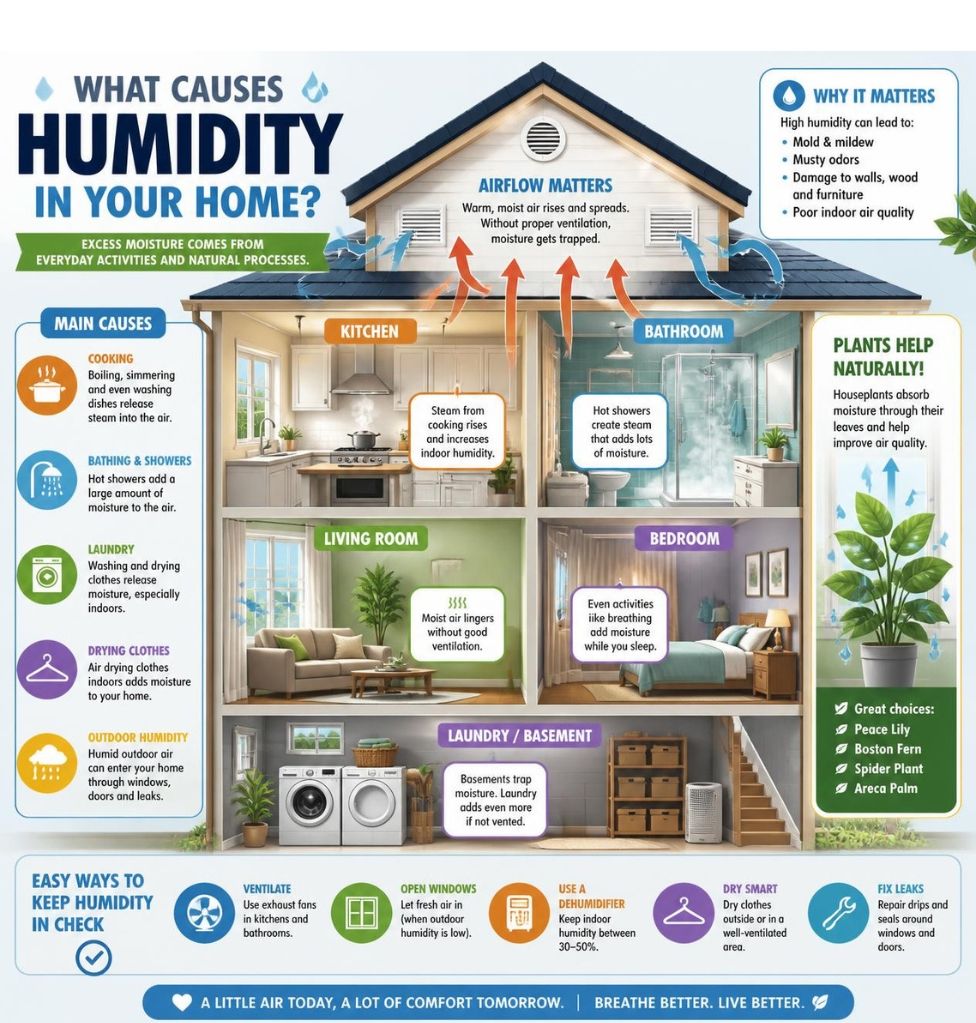
Your air conditioner does two jobs at once: it lowers temperature (sensible cooling) and removes moisture (latent cooling). When the house feels cool but clammy, it's the moisture-removal side that's falling short. Here are the most common reasons.
1. Your AC is oversized and short-cycling
This is the number-one hidden cause. An air conditioner removes humidity gradually, over the course of a full cooling cycle. If the unit is too large for your home, it cools the air quickly, hits the target temperature, and shuts off before it has run long enough to wring the moisture out. It then kicks back on a few minutes later, a pattern called short cycling. The result is a cold but damp house. Bigger is not better when it comes to AC sizing.
2. The thermostat fan is set to "ON" instead of "AUTO"
This one you can fix in ten seconds. When the fan is set to ON, it runs constantly, even when the AC isn't actively cooling. Moisture that just condensed on the cold evaporator coil gets blown right back into your home before it can drain away. Set the fan to AUTO so it only runs during cooling cycles, and that condensed water drains out as designed.
3. A dirty air filter
A clogged filter restricts airflow across the evaporator coil. That hurts the system's ability to both cool and dehumidify, and it can even cause the coil to freeze. Check your filter monthly and replace it every 1–3 months.
4. Low refrigerant
If your system is low on refrigerant, usually because of a leak, the evaporator coil can't get cold enough to condense moisture out of the air effectively. You'll often notice weaker cooling alongside the humidity. This one requires a licensed technician to diagnose and repair.
5. Leaky or poorly sealed ducts
If your ductwork runs through a hot attic or crawlspace and has leaks, it can pull in warm, humid, unconditioned air and distribute it through your home. Sealing and insulating ducts keeps that moisture out.
6. An aging or undersized system
An older AC simply loses efficiency over time and may no longer dehumidify like it used to. Less commonly, a unit that's too small runs constantly and still can't keep up with the moisture load.
7. Too much moisture coming in
Sometimes the AC is fine and the home is just producing or admitting a lot of moisture, long hot showers without exhaust fans, cooking without ventilation, drying laundry indoors, a damp basement or crawlspace, or humid outside air leaking in through gaps and doors. In very humid climates like Texas and Florida, outdoor air alone can overwhelm what an AC is designed to handle.
Signs High Humidity Is Becoming a Problem
Watch for these red flags that indoor moisture has crept too high:
- Condensation on windows, mirrors, or cold surfaces
- A persistent musty or damp smell
- Clammy or sticky air, even when the temperature feels fine
- Visible mold or mildew on walls, ceilings, grout, or around vents
- Warping of wood floors, doors, or trim
- Peeling paint or wallpaper
- Worsening allergy or respiratory symptoms
High humidity isn't just a comfort issue. Sustained moisture is the leading cause of mold growth in a home, including inside your ductwork. If you're seeing mold or smelling must from your vents, it's worth reading our companion guide on whether mold in your air ducts can make you sick.
How to Reduce Humidity in Your House
Start with the simple fixes, then escalate if the problem persists.
Quick DIY fixes:
- Switch the thermostat fan to AUTO (see cause #2 — this alone solves a lot of cases).
- Replace a dirty air filter.
- Use exhaust fans in bathrooms and the kitchen, and run them for a bit after showering or cooking.
- Use your AC's "Dry" or "Dehumidify" mode if it has one — it prioritizes moisture removal over cooling.
- Seal obvious air leaks around doors and windows.
- Fix any water intrusion — leaks, damp crawlspaces, poor drainage near the foundation.
When DIY isn't enough, get a dehumidifier:
If you've handled the basics and the house is still humid, a dehumidifier is the most reliable fix. A whole-house dehumidifier integrates with your HVAC system and controls humidity throughout the homem the best option for consistently humid climates. A portable unit is cheaper and works well for a single problem room like a bedroom or basement.
Dehumidifier vs. AC: your AC removes some humidity as a byproduct of cooling, but it's not built to control humidity precisely. A dehumidifier targets moisture directly, which is why the two work best together in humid regions rather than one replacing the other.
AC Problems Worth Calling a Pro For
Some causes are beyond a DIY fix and need a licensed technician. Call a professional if:
- Your AC is short cycling (turning on and off frequently) — likely a sizing or component issue.
- You suspect the unit is oversized or undersized — a pro can run a load calculation to confirm.
- Cooling is weak and the house is humid — a classic sign of low refrigerant or a failing component.
- You have leaky ducts that need sealing.
- The system is old and no longer keeping up despite maintenance.
An annual HVAC tune-up catches most of these before they become summer emergencies, and keeps your system dehumidifying the way it should.
Frequently Asked Questions
Why is my house humid even with the AC on?
Most often it's an oversized AC that cools too fast to remove moisture, the fan set to ON instead of AUTO, a dirty filter, low refrigerant, or leaky ducts. The AC lowers temperature but isn't running long enough, or efficiently enough, to pull humidity out.
Should my AC fan be on "auto" or "on" for humidity?
Use AUTO. On the ON setting, the fan runs constantly and blows moisture off the coil back into your home before it can drain. AUTO lets that condensation drain away properly, so your house stays drier.
Can an oversized AC cause high humidity?
Yes, it's one of the most common causes. An oversized unit cools the air quickly and shuts off before completing a full cycle, so it never runs long enough to remove moisture. This short cycling leaves the house cold but clammy.
Does turning the thermostat lower reduce humidity?
Not reliably. A lower setpoint can make the AC run longer, which removes some extra moisture, but it also overcools and wastes energy. For a real humidity problem, fix the underlying cause or add a dehumidifier rather than just dropping the temperature.
Will a dehumidifier help if I already have AC?
Yes. An AC removes humidity only as a side effect of cooling and can't control it precisely. A dehumidifier targets moisture directly, so the two complement each other, especially valuable in humid climates like Texas and Florida.
Can a dirty air filter cause humidity?
Yes. A clogged filter restricts airflow across the evaporator coil, which reduces the system's ability to dehumidify and can cause the coil to freeze. Checking your filter monthly and replacing it regularly is one of the easiest fixes.
What is a good indoor humidity level in summer?
Aim for 30–50%, ideally around 45%. In summer, staying toward the lower-to-middle of that range keeps the house comfortable and discourages mold and dust mites.
Why is my house more humid at night?
Outdoor humidity often rises overnight as temperatures drop toward the dew point, and if the AC cycles less at night it removes less moisture. Running exhaust fans and keeping the fan on AUTO helps.
Can low refrigerant cause high humidity?
Yes. Low refrigerant keeps the evaporator coil from getting cold enough to condense moisture out of the air, so the system cools weakly and leaves the house humid. This needs a licensed technician to fix, since low refrigerant usually means a leak.
Is high humidity in the house bad for my health?
It can be. High indoor humidity promotes mold, mildew, and dust mites, which trigger allergies and asthma. If you're worried about mold specifically, see our guide on whether mold in air ducts can make you sick.
Still Sticky? Team Enoch Can Help
If you've tried the basics and your house is still humid, the problem is likely in the AC itself — sizing, refrigerant, ducts, or an aging system. Team Enoch's HVAC experts serve the Texas Triangle, Dallas, Fort Worth, Arlington, Austin, San Antonio, and Houston, plus Orlando and Tampa. We'll diagnose why your system isn't controlling humidity and recommend the right fix, whether that's a tune-up, a repair, or a whole-house dehumidifier. No subcontractors, upfront pricing, and no payment until the work is done.
Call us at (817) 769-3712 or request a quote to get your comfort back.