
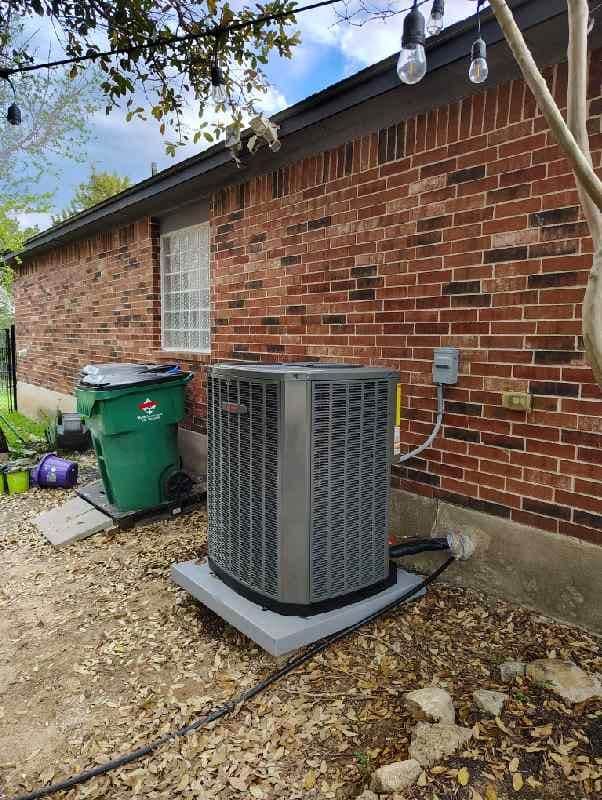
What if the air conditioning unit you've been planning to buy is actually the wrong purchase for your home? Not wrong because it's a bad product. Wrong because there's another system that cools your home just as well in summer, heats it through winter, costs less to run every single month, and even qualifies for a federal tax credit your AC unit never will. That system exists. It's called a heat pump. And most Texas homeowners have never seriously considered it.
We're going to cut through the noise and give you the real answer, including the stuff most HVAC companies skip over because they just want to sell you the more expensive option.
What's the Actual Difference Between a Heat Pump and an AC Unit?
Here's the simplest way to think about it.
An AC unit does one job: it cools your home. It pulls heat out of your indoor air using refrigerant and evaporator coils, runs it through the compressor, and dumps that heat outside. That's it. When winter arrives, your AC shuts off and your furnace takes over.
A heat pump does that same cooling job in summer, but in winter it runs the process in reverse. Instead of moving heat out of your home, it pulls heat from the outdoor air and brings it inside. Yes, even cold outdoor air contains usable heat energy, and a heat pump is built to extract it.
So the core difference comes down to this: an AC unit is a one-way cooling machine, and a heat pump is a two-way heating and cooling system.
One system, two functions. That's the entire concept.
Heat Pump vs AC Unit Cost: Which One Is Cheaper?
This is where most people get tripped up because they compare the wrong numbers.
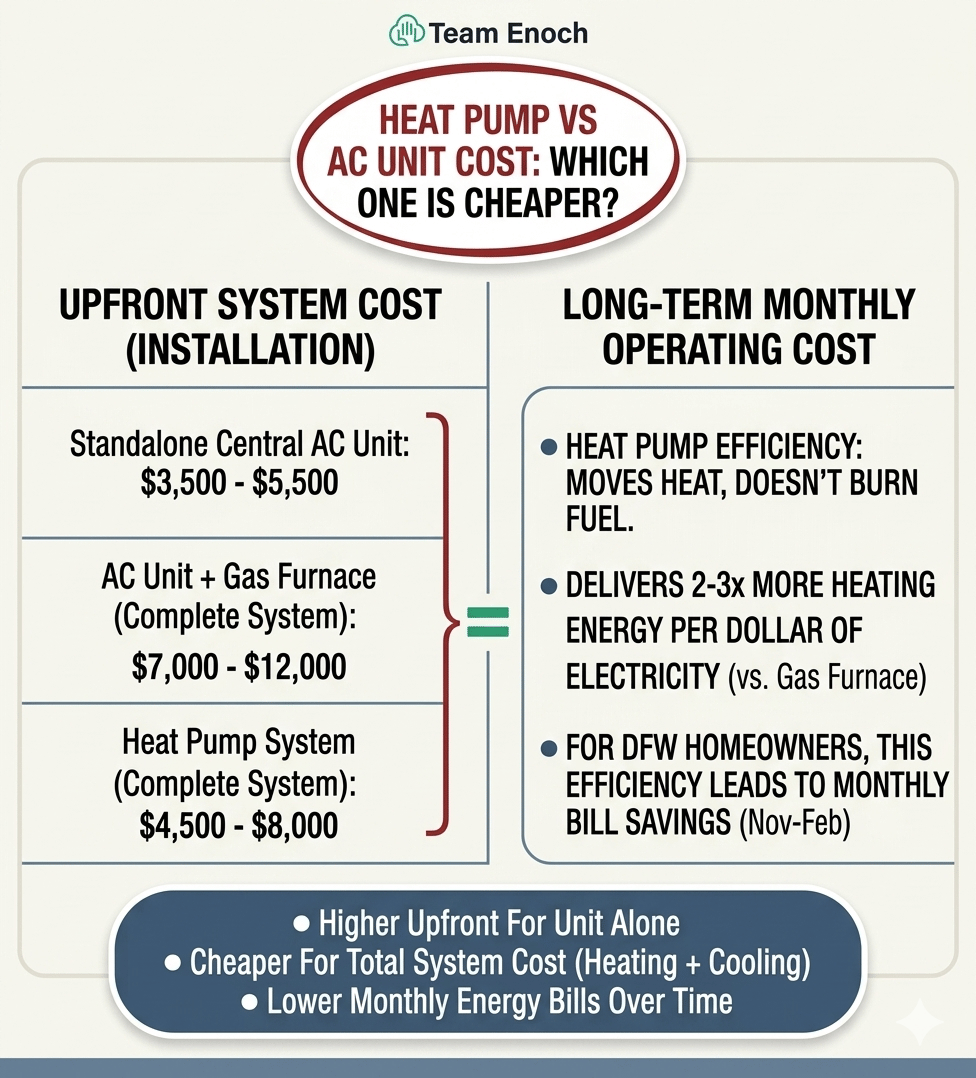
A heat pump has a higher upfront cost than a standalone AC unit. A basic central AC installation might run you $3,500 to $5,500 depending on your home size and existing ductwork. A comparable heat pump system typically costs $4,500 to $8,000 installed.
But here's what that comparison misses: if you only have an AC, you still need a heating system.
Add a gas furnace to that AC unit and suddenly you're looking at $7,000 to $12,000 for two separate systems. Compare that to a single heat pump that handles both, and the heat pump often wins on total installation cost.
The monthly cost picture also shifts over time. Because a heat pump moves heat rather than burning fuel to generate it, it can deliver two to three times more heating energy per dollar of electricity than a gas furnace. For DFW homeowners who run their heat from November through February, that efficiency advantage adds up quickly on your utility bills.
Short answer on cost: Higher upfront for the unit alone, but often cheaper when you compare total system cost (heating plus cooling), and lower monthly energy bills over the long run.
Heat Pump vs AC Unit Pros and Cons
Heat Pump Pros
- Heats and cools from one system, one unit, one set of maintenance
- Significantly more energy efficient for heating than a gas furnace
- Lower carbon footprint and better for the environment
- Qualifies for federal tax credits and utility rebates that AC units typically don't
- Ideal for the mild to moderate winters across most of Texas
Heat Pump Cons
- Higher upfront purchase price compared to an AC-only unit
- Loses efficiency in extreme cold (below 30 to 35 degrees Fahrenheit)
- May need a backup heat source if you live somewhere with harsh winters
- Less familiar to some HVAC technicians, though this is changing fast
AC Unit Pros
- Lower upfront cost for the cooling equipment itself
- Simple, widely understood technology
- Works well paired with a high-efficiency gas furnace in colder climates
- Easier to find replacement parts anywhere
AC Unit Cons
- Only cools, requires a completely separate heating system
- Two systems means twice the maintenance, twice the potential for repairs
- Gas furnaces burn fossil fuels, increasing your carbon footprint and energy bills
- Does not qualify for the same energy efficiency tax credits as heat pumps
Heat Pump vs AC and Furnace: Which Setup Actually Makes More Sense?
This is the real question most homeowners should be asking, not just heat pump vs AC, but heat pump vs the full AC plus furnace setup.
For most homeowners in the DFW Metroplex, Austin, Houston, and San Antonio, a heat pump wins this comparison. Here's why:
Texas winters are mild. Dallas averages only about 25 days per year where the temperature drops below freezing. Fort Worth, Arlington, Austin, and San Antonio see similar patterns. This is precisely the moderate climate where heat pumps operate at peak efficiency all winter long without ever struggling.
You don't need a powerful gas furnace to survive a Texas winter. What you need is an efficient, reliable system that handles both the long hot summers and the short, cool winters without costing you a fortune to run.
A heat pump does that job better than an AC and furnace combo in this region. One system, lower operating costs, and a simpler maintenance situation.
The only scenario where we'd lean toward an AC and furnace combo in Texas is if you already have a newer, high-efficiency furnace that has plenty of life left in it. In that case, replacing just the AC unit makes more financial sense than scrapping a working furnace to buy a heat pump.
Why Are Heat Pumps More Efficient Than Air Conditioners?
This question comes up a lot, and the answer is surprisingly simple once you understand the mechanics.
An air conditioner and a heat pump cool your home using the exact same process. In cooling mode, their efficiency is identical for units with the same SEER (Seasonal Energy Efficiency Ratio) rating. A heat pump doesn't magically cool better than an AC.
The efficiency advantage for heat pumps shows up entirely in the heating side.
A gas furnace generates heat by burning fuel. It converts the chemical energy in natural gas into heat, and even the most efficient furnaces top out at around 98% efficiency, meaning you get 98 cents of heat for every dollar of gas burned.
A heat pump doesn't generate heat. It moves existing heat from one place to another. Because you're moving energy rather than creating it, a heat pump can deliver 200% to 300% efficiency, meaning you get two to three dollars of heat for every dollar of electricity consumed. This is measured as the Coefficient of Performance (COP), and it's why your electric bill looks so much better with a heat pump compared to electric baseboard heating.
Against a gas furnace, the comparison is closer and depends heavily on your local electricity and gas rates. But in most Texas markets, heat pumps remain competitive or better on monthly heating costs.
Is a Heat Pump Worth It in Texas?
Yes, for most Texas homeowners the answer is clearly yes, and here's the specific reason.
Heat pump efficiency drops in very cold weather. When outdoor temperatures fall below freezing for extended periods, a heat pump has to work harder and eventually needs backup heating support. This is why heat pumps get a bad reputation in states like Minnesota, Wisconsin, or upstate New York.
Texas is not those states.
The DFW Metroplex sees average January lows around 33 to 38 degrees Fahrenheit. Austin runs slightly warmer. Houston and San Antonio are milder still. These temperatures are squarely in the sweet spot where a heat pump operates efficiently without any backup heat source needed.
Even during a cold snap that drops temperatures into the 20s, a modern cold-climate heat pump handles it well. And those cold snaps in Texas rarely last more than a few days before temperatures climb back up.
If you're in Dallas, Fort Worth, Arlington, Plano, Frisco, McKinney, or anywhere else in the Metroplex, a heat pump is not just worth it, it's often the smartest HVAC investment you can make.
Should I Replace My AC with a Heat Pump?
If your AC is 10 to 15 years old and showing signs of wear, this is the perfect time to ask the question. Here's how to think through it.
Replace your AC with a heat pump if:
- Your AC is approaching or past 10 to 15 years old
- Your furnace is also aging and may need replacement within the next few years
- You want to reduce your monthly energy bills
- You want to qualify for the federal Inflation Reduction Act tax credit (up to $2,000 for heat pump installation)
- You care about reducing your home's carbon footprint
- You live anywhere in the Texas Triangle where winters are mild
Stick with an AC replacement if:
- Your furnace is newer and still has good years left
- Your budget is tight and the upfront cost difference is a real constraint right now
- You live somewhere with genuinely harsh, prolonged winters (not typical for Texas)
One more thing worth knowing: when you replace an aging AC with a heat pump, you're not just getting a new cooling system. You're effectively future-proofing your home comfort setup so you won't have to replace two systems in two separate years. That alone saves most homeowners significant money and hassle.
Why Is My Electric Bill So High with a Heat Pump?
This question shows up constantly and it almost always has one of three causes.
First, your heat pump may be improperly sized for your home. An undersized unit runs constantly trying to keep up and drives your electric bill up. This is why proper load calculation during installation matters so much.
Second, your heat pump may be running on backup emergency heat more than it should. Emergency heat is typically electric resistance heat strips, which are far less efficient than the heat pump itself. If your system switches to emergency heat at mild temperatures, something is wrong with the system or the settings.
Third, your home may have insulation or air sealing issues that are making any heating or cooling system work harder than it should. This isn't a heat pump problem, it's a home efficiency problem.
If you're seeing unexpectedly high bills after a heat pump installation, call an HVAC professional to audit the system before assuming heat pumps are inherently expensive to run. In most cases, a well-installed, properly sized heat pump in a Texas home will reduce your combined heating and cooling costs compared to a gas furnace and AC combination.
Heat Pump vs AC Unit Efficiency: The Numbers Breakdown
Standard AC Unit | Heat Pump (Cooling) | Heat Pump (Heating) | Gas Furnace | |
|---|---|---|---|---|
Efficiency Rating | SEER 14 to 20+ | Same SEER as AC | COP 2.0 to 4.0 | AFUE 80% to 98% |
Fuel Type | Electricity | Electricity | Electricity | Natural Gas |
Best Climate | Any | Any | Mild to moderate | Any |
Carbon Footprint | Moderate | Moderate | Low | Higher |
Qualifies for Tax Credits | Limited | Yes | Yes | Limited |
What the $5,000 Rule for HVAC Means
You may have heard of the $5,000 rule for deciding whether to repair or replace an HVAC system. The idea is simple: multiply the age of your unit by the repair cost. If that number exceeds $5,000, replacement makes more financial sense than repair.
For example, if your 12-year-old AC needs a $500 compressor repair: 12 x $500 = $6,000. That's over the $5,000 threshold, which suggests putting that money toward a new system instead.
This rule is a useful starting point, but it's not gospel. The real variables are your unit's overall condition, whether refrigerant issues are involved, and what replacement options are available in your budget. A good HVAC technician will walk you through the honest math rather than pushing you toward whichever option makes them more money.
Government Rebates and Tax Credits: Heat Pumps Win Here Too
This is a factor that doesn't get nearly enough attention.
The Inflation Reduction Act created federal tax credits specifically designed to encourage home electrification. Homeowners who install a qualifying heat pump can claim a federal tax credit of up to $2,000. There are also income-based rebates through the High Efficiency Electric Home Rebate Act (HEEHRA) that can reach up to $8,000 for heat pump installation.
Standard AC units paired with gas furnaces generally don't qualify for these credits.
If you're already considering a new system, the tax credit alone can significantly close the upfront cost gap between a heat pump and a traditional AC and furnace setup.
Talk to your HVAC installer and your tax professional about what you qualify for before making a final decision.
What Makes Team Enoch Different When You're Ready to Decide
We know you have choices when it comes to HVAC service in Dallas, Fort Worth, Arlington, Austin, Houston, and San Antonio. Here's what sets us apart from the competition.
We never use subcontractors. Every technician who shows up at your home is a trained, vetted member of our own team. We accept payment after service completion, not before. And we back every job with a price guarantee. If a reputable contractor beats our price, we want to know about it.
More importantly, we're going to give you an honest recommendation for your specific home and situation. If a heat pump is the right call, we'll tell you. If replacing just the AC unit makes more financial sense given what you already have, we'll tell you that too.
We've installed and serviced thousands of heat pump and AC systems across the Texas Triangle. We know what works in this climate, what lasts, and what gives homeowners the best return on their investment over time.
Ready to Make the Right Call for Your Home?
Still weighing heat pump vs AC unit for your home? Let's figure it out together. Our team will assess your current system, factor in your home size, your heating and cooling usage, and your budget, and give you a clear, honest recommendation with no pressure.
📞 Call Team Enoch: 817-769-3712 📍 Serving Arlington, Fort Worth, Dallas, Plano, McKinney, Frisco, Austin, Houston, San Antonio, and surrounding areas
Fill out our quick online form to get a free quote and talk to one of our HVAC experts today.
Team Enoch has been delivering reliable HVAC, electrical, and plumbing services across the Texas Triangle and Florida since 2015. With 15,000+ residential jobs completed per year and a 4.9 out of 5.0 Google rating backed by over 5,000 positive reviews, we are the team your neighbors trust.