Why Poor Attic Insulation Makes Your AC Work Harder
Poor attic insulation makes your AC work harder and raises energy bills. Learn how insulation impacts cooling efficiency and what to fix.
Team Enoch
April 10, 2026
Your attic is probably the single most important space in your home that you almost never think about. It sits above everything else, baking in direct sunlight for hours every day, and most homeowners only venture up there when they absolutely have to. But that space, specifically, what's between your attic floor and your ceiling, determines how hard your air conditioner has to work, how much you pay in energy bills every month, and whether your upstairs rooms ever feel comfortable in summer.
Your attic is the largest source of energy loss in your home, responsible for up to 25% of the heat that escapes during winter and heat that infiltrates during summer. That's not a worst-case estimate. That's the reality for millions of homes with attic insulation that's either too thin, too old, improperly installed, or simply missing in critical areas.
According to the U.S. Department of Energy, upgrading attic insulation can reduce heating and cooling costs by 10 to 20 percent. That translates to anywhere from $200 to $400 in annual savings for most homeowners. For most households, that pays back the insulation upgrade cost within 3–5 years, and then continues delivering savings for the next 15–20 years after that.
This guide explains exactly why poor attic insulation forces your AC to work harder, what's actually happening in your attic during a Texas summer, how to know if your insulation is inadequate, what proper insulation should look like, and what the upgrade process involves.
On a typical summer day in Texas when the outdoor temperature hits 95–100°F, your attic isn't just a little warmer than outside. Research from Oak Ridge National Laboratory and studies conducted by the Florida Solar Energy Center document that most attics reach 120–150°F on typical summer days, and in the hottest regions, temperatures can exceed 160°F. That's often 40–60 degrees hotter than the outside air.
Let that sink in for a moment. Your outdoor thermometer reads 98°F. Your attic is sitting at 145°F, nearly 50 degrees hotter. Your living space below is trying to maintain 74°F. That means there's a 70-degree temperature differential between your attic and your living space, with nothing but ceiling drywall and whatever insulation you have (or don't have) standing between them.
Studies published by Lawrence Berkeley National Laboratory found that the cooling load for a home air conditioner depends heavily on the difference in temperature between the inside and outside air. Reduction of attic temperatures from 155 degrees to 105 degrees Fahrenheit results in significant reductions in cooling load. In homes with poor ceiling insulation, heat movement through ceilings may account for 30 percent or more of total cooling costs.
Here's what's creating that extreme heat:
Solar Radiation: Your roof absorbs sunlight all day long. Dark asphalt shingles, the most common roofing material in Texas, absorb and hold significantly more heat than lighter-colored materials. Research from the Cool Roof Rating Council demonstrates that this absorbed heat eventually gets re-radiated into the attic space, causing attic temperatures to easily reach 130 to 140 degrees Fahrenheit on typical summer days.
Lack of Airflow: Without proper ventilation, that heat has nowhere to go. It accumulates in the attic space hour after hour. Even with ventilation, if your attic lacks adequate insulation on the floor, the heat still radiates downward into your living spaces.
Ductwork Heat Gain: Here's the compounding problem most homeowners don't realize: if your air conditioning ductwork runs through your attic, and in most Texas homes, it does, those ducts are sitting in 140–150°F air while carrying 55°F cooled air inside them.
Studies from the California Energy Commission found that the surface area of ductwork for a typical home is about 40 percent of a home's floor area. Basic heat transfer calculations for a 2,000-square-foot home show that attic heat conducted into R-2 insulated ductwork adds approximately 30,500 BTUs per hour of cooling load, more than 2.5 tons of air conditioning capacity. Even with today's code requirement of R-8 ductwork insulation, the additional heat load is still 8,000 BTUs per hour, or 0.67 tons of cooling capacity.
What this means practically: your AC cools air to 55°F, sends it through ducts running through a 145°F attic, and by the time that air reaches your supply registers, it has absorbed significant heat along the way. Your system has to run longer to overcome that heat gain, burning more electricity and wearing out components faster.
When your attic insulation is inadequate, your air conditioning system responds in predictable ways, none of them good for your comfort or your wallet.
Longer Run Times
An HVAC system with ductwork in an attic space has to work considerably harder to compensate for extreme ambient temperatures. Even if your HVAC equipment itself is in the basement or a downstairs closet, if ductwork runs through the attic, the ambient temperature there still significantly impacts system efficiency.
Your thermostat is set to 74°F. The system starts a cooling cycle, brings the temperature down to setpoint, and shuts off. In a well-insulated home, the temperature stays stable for a reasonable period because the insulation is preventing outdoor heat from flowing in. In a poorly insulated home, heat from the attic immediately begins radiating downward through the ceiling. The indoor temperature climbs back above setpoint within minutes. The system kicks back on. This cycle repeats constantly, with shorter off-times and longer on-times than the system was designed for.
The result: your compressor runs far more hours per day than it should, accumulating wear faster and burning more electricity continuously.
Inability to Reach Setpoint
In extreme cases, the system runs continuously and never satisfies the thermostat. This is particularly common on peak summer days (100°F+) in homes with severely inadequate attic insulation. The heat gain from the attic exceeds the cooling capacity the system can deliver. The indoor temperature hovers 3–5 degrees above setpoint no matter how long the AC runs.
Homeowners in this situation often assume their AC is broken or undersized. In many cases, the equipment is fine, it's simply fighting a thermal battle it can't win because the attic is dumping heat into the home faster than the AC can remove it.
Dramatically Higher Energy Bills
Research published by building science experts and documented in studies from the Building America Program shows that relocating ductwork from unconditioned attic space to conditioned living space can reduce required AC capacity by approximately 24%. Additionally, cooling energy usage decreases by 17%, and peak cooling demand drops by 22%.
Those numbers are for moving ductwork entirely out of the attic, an expensive proposition. But they illustrate how much the attic environment affects system performance. Even without moving ducts, upgrading attic insulation significantly reduces the heat load the system has to handle, which translates directly to lower monthly bills.
A typical Texas home spending $250/month on electricity during summer might see $40–$75/month in savings from proper attic insulation, $400–$750 per cooling season, year after year.
Understanding what proper insulation should be helps homeowners evaluate whether their own attic measures up.
R-Value: The Measurement That Matters
R-value is a measure of insulation's ability to resist heat flow. The higher the R-value, the better the thermal performance of the insulation material. The "R" stands for resistance, specifically, resistance to heat transfer. An R-30 material resists heat flow better than R-19, and R-49 performs better than R-30.
Texas Climate Zone Recommendations
Texas is divided into two primary climate zones for building code purposes according to the International Energy Conservation Code (IECC):
Zone 2 covers Southern Texas, including Houston, Austin, San Antonio, and the Gulf Coast region. Zone 3 covers Central Texas, including Dallas-Fort Worth and surrounding areas.
According to recommendations from the U.S. Department of Energy's Office of Energy Efficiency and Renewable Energy, homes in mild climates should have a minimum attic insulation grade of R-38, or about 13–14 inches of insulation. Homes in colder climates should target R-49 as the minimum recommendation, or about 16–18 inches of insulation.
For most Texas homes, R-38 to R-49 is the target range. The recommended insulation level for most attics according to DOE guidelines is an R-value between 30 and 60, with the specific target depending on climate zone and heating/cooling degree days.
What That Looks Like in Actual Thickness
Different insulation materials achieve R-values at different rates per inch. Understanding how different materials perform helps you calculate the depth of insulation your attic requires:
Fiberglass batts: Roughly R-3.2 per inch according to manufacturer testing standards. To reach R-38, you need approximately 12 inches. To reach R-49, you need approximately 15 inches.
Blown-in cellulose: Roughly R-3.6 per inch when installed at proper density. To reach R-38, you need approximately 11 inches. To reach R-49, you need approximately 14 inches.
Blown-in fiberglass: Similar performance to cellulose, roughly R-3.0–R-3.8 per inch depending on density and settling characteristics.
Closed-cell spray foam: Roughly R-6 to R-7 per inch according to ASTM testing standards. To reach R-38, you need approximately 6 inches. To reach R-49, you need approximately 7–8 inches.
To achieve R-49 insulation levels, you would need approximately 14 to 16 inches of blown-in cellulose or fiberglass batts, but only 7 to 8 inches of closed-cell spray foam due to its higher R-value per inch.
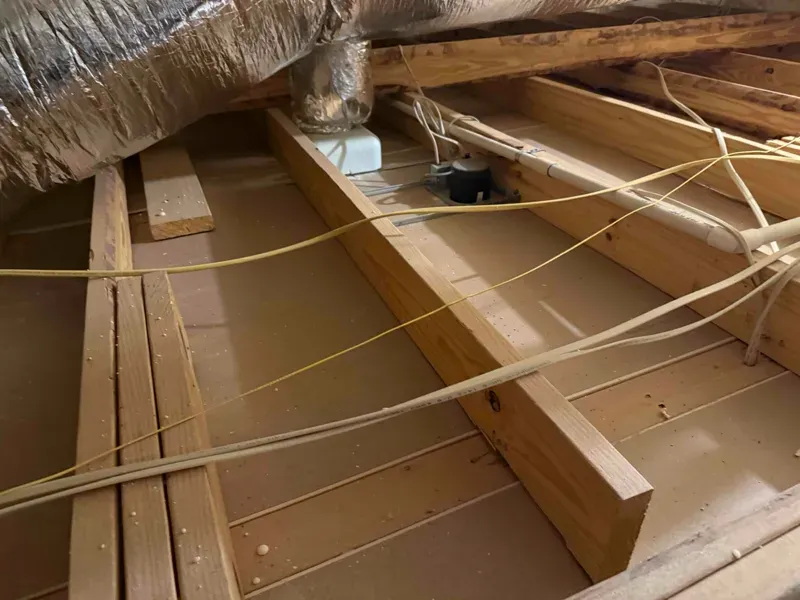
A quick way to determine whether you have enough insulation is to visually inspect your attic. If the insulation material is level with or below the floor joists, you probably need to add more. If you can't see the joists because the insulation is well above them, you likely have adequate coverage.
Homes built before the 1980s most likely have significantly underperforming attic insulation. Air sealing wasn't part of standard planning and construction practices during that era. Often, these older homes have only a few inches of fiberglass batting, or sometimes even outdated materials like rock wool, sawdust, or shredded paper.
If your home was built before 1980, there's a strong probability that your attic insulation is nowhere near current standards established by the Department of Energy and ENERGY STAR programs. Homes from the 1960s and 1970s often have 3–6 inches of fiberglass batts, which delivers roughly R-10 to R-19, less than half of what Texas homes need according to current building science research.
By the 1980s and 1990s, builders began installing blown-in fiberglass and cellulose more commonly. These materials filled gaps more effectively and could be installed more quickly than batts. While better in many ways than earlier practices, blown-in insulation installed during this period has limitations. Because it sits on the attic floor, the space above it remains extremely hot in summer. Any HVAC ductwork or air conditioning equipment located in the attic space is exposed to extreme heat, which significantly reduces system efficiency.
Even homes built in the 1990s and early 2000s often fall short of today's energy efficiency standards. Building codes have evolved significantly over the past two decades based on new research from organizations like Oak Ridge National Laboratory and the National Renewable Energy Laboratory. What was considered "adequate" in 2000 is now recognized as insufficient for managing Texas heat effectively.
Many homes in the Dallas-Fort Worth area and throughout Texas face a perfect storm of insulation challenges. Construction practices in the 1980s, 1990s, and early 2000s did not incorporate the energy efficiency standards we understand today through building science research. Combined with harsh summer heat, mild but unpredictable winters, and aging insulation materials that settle and compress over time, this creates ideal conditions for uncomfortable temperature variations, especially in upstairs living spaces.
Even homes that technically have "enough" insulation by thickness can lose efficiency due to installation problems or degradation over time. Here are the most common issues identified in building energy audits:
Compressed or Settled Insulation
Blown-in fiberglass and cellulose settle over time, particularly if they were installed at low density. What started as 14 inches of coverage might be only 9 inches a decade later. Compressed insulation loses R-value because the air pockets that provide thermal resistance are squeezed out. Research from the Building Science Corporation shows that compressed insulation can lose one-third or more of its rated R-value.
Gaps and Bare Spots
Insulation that's missing around recessed light fixtures, plumbing penetrations, attic hatches, and HVAC equipment creates thermal bridges, direct pathways for heat to flow from the attic into your living space. Studies conducted by Lawrence Berkeley National Laboratory demonstrate that even if 95% of your attic floor is well-insulated, that missing 5% around penetrations can account for a disproportionate amount of heat gain due to focused thermal bridging.
Improperly Installed Batts
Fiberglass batts that are improperly cut, compressed to fit around obstacles, or installed with gaps between pieces perform far below their rated R-value. Air flowing through and around poorly installed batts bypasses the insulation entirely. The Oak Ridge National Laboratory has published studies showing that improper installation can reduce effective R-value by 50% or more compared to laboratory-tested values.
Moisture Damage and Mold
Insulation that has been wet from roof leaks, condensation, or plumbing leaks loses R-value permanently in many cases. Wet fiberglass compresses and doesn't regain its original thickness or performance even after drying. Cellulose that gets wet can develop mold, creating both a performance problem and an indoor air quality concern. Research from the Environmental Protection Agency confirms that moisture-damaged insulation should be removed and replaced rather than allowed to dry in place.
Air Leakage
Air leaks around attic hatches, recessed lighting, and ductwork allow warm air to enter living spaces in the summer and heated air to escape in the winter. Insulation slows conductive heat transfer, heat moving through solid materials. But it does nothing to stop convective heat transfer, hot air physically moving from the attic into your home through gaps and cracks. Building science research consistently demonstrates that air sealing and insulation must work together; neither is fully effective without the other.
You don't need professional equipment to identify obvious insulation problems. Here are the signs every homeowner can check:
Visual Inspection
Go into your attic on a sunny afternoon (bring a flashlight, wear long sleeves and a dust mask, and watch your step, only step on ceiling joists, never on drywall or insulation). Look at the insulation depth. If floor joists are clearly visible or insulation appears thin, patchy, or unevenly distributed, more material is needed.
Measure the depth with a ruler or tape measure in several locations across the attic. If you're seeing less than 10–12 inches of blown-in insulation or less than 12 inches of fiberglass batts, you're below recommended levels for Texas climate zones according to DOE guidelines.
Upstairs Temperature Problems
Look for these warning signs that indicate inadequate attic insulation:
Your upstairs is several degrees warmer (or colder) than the downstairs consistently. The HVAC system runs almost constantly but doesn't seem to help maintain comfortable temperatures. Utility bills are especially high in the summer or winter months compared to similar homes in your area. Ceiling vents are blowing lukewarm air even when the AC is actively running. You notice drafty hallways, especially near attic access hatches.
If your second floor is consistently 3–5 degrees warmer than the first floor during summer, inadequate attic insulation is almost always a contributing factor. While heat naturally rises, in a well-insulated home that heat shouldn't be radiating down through the ceiling in a way that makes upstairs rooms noticeably warmer than downstairs spaces.
Ceiling Surfaces Feel Warm
Touch your interior ceilings during the hottest part of a summer afternoon. If they feel noticeably warm to the touch, warmer than the surrounding air temperature, heat is conducting through inadequate insulation from the attic above. This is a clear indicator that your insulation barrier is insufficient for Texas summer conditions.
During cold weather, the same test applies in reverse: if ceilings feel noticeably cold, heat is escaping upward through insufficient insulation.
AC Runs Constantly Without Satisfying Thermostat
If your air conditioner runs continuously without ever reaching the thermostat setting, heat gain through inadequate attic insulation could be forcing the system to work beyond its capacity to compensate.
An air conditioner sized correctly for your home should cycle on and off in roughly 15–20 minute intervals on moderate summer days, and 20–30 minute cycles on peak heat days. If it's running constantly for hours without achieving the setpoint temperature, heat gain from the attic is likely overwhelming the system's capacity.
Energy Bills Have Increased Over Time
If your summer electricity bills have climbed steadily over the years without a corresponding increase in utility rates or changes in your usage patterns, degraded attic insulation may be the cause. Insulation doesn't improve with age, it settles, compresses, becomes contaminated with dust, and loses effectiveness over time.
Let's quantify what poor insulation actually costs over time, because the numbers are more significant than most homeowners realize.
Monthly Energy Cost
A typical 2,000-square-foot home in Texas with inadequate attic insulation (R-15 to R-20 when it should be R-38 to R-49) might spend an extra $50–$100 per month on cooling during summer compared to the same home with proper insulation. Over a six-month cooling season, that's $300–$600 annually in unnecessary energy costs that could have been avoided.
Investing in proper attic insulation delivers measurable financial returns. According to ENERGY STAR program data maintained by the Environmental Protection Agency, homeowners can save an average of 15% on heating and cooling costs, or approximately 11% on total energy costs, by air sealing their homes and adding insulation in attics, floors over crawl spaces, and basement rim joists.
For a household spending $2,400 annually on heating and cooling, a 15% savings represents $360 per year. That savings continues every year for the lifespan of the insulation, typically 20+ years for properly installed blown-in or spray foam products.
Equipment Wear and Lifespan
Your AC compressor, blower motor, and capacitor all accumulate operating hours. An air conditioner forced to run 30% more hours per season because of inadequate insulation reaches its wear-out point 30% sooner than it would under normal operating conditions. A system that should last 15 years under normal conditions fails at 10–11 years instead when subjected to this level of overuse.
For a residential HVAC system costing approximately $7,000 to replace, that represents $7,000 spent 4–5 years earlier than necessary, a direct result of inadequate attic insulation forcing premature equipment failure.
Comfort Cost
This one doesn't show up on a utility bill, but it's real: living in a home where upstairs bedrooms are 5 degrees warmer than downstairs spaces, where the AC runs constantly and still can't maintain comfortable temperatures, and where summer energy bills create financial anxiety every month has a significant quality-of-life cost that's difficult to quantify in dollars but impossible to ignore for families living with the problem daily.
Understanding the upgrade process helps homeowners make informed decisions and set realistic expectations for the work involved.
Step 1: Attic Inspection and Air Sealing
Before adding insulation, a thorough inspection identifies air leakage points that must be sealed. This includes gaps around plumbing and electrical penetrations, spaces around recessed light fixtures, the attic hatch or pull-down stairs, and any ductwork connections or chases. Air sealing is accomplished using spray foam for larger gaps, caulk for smaller penetrations, or specialized sealants depending on the gap size and location.
Research from Oak Ridge National Laboratory demonstrates that air sealing before adding insulation is critical for achieving rated thermal performance. Homeowners often see immediate benefits from air sealing work. Even simple fixes like properly sealing the attic hatch, adding a few more inches of loose-fill insulation, or blocking wind intrusion near eaves can reduce energy waste measurably.
Step 2: Choosing Insulation Material
The three most common options for Texas attic upgrades are:
Blown-in Fiberglass: Cost-effective option, non-combustible, doesn't settle as dramatically as cellulose over time. Good moisture resistance compared to other options. Achieves R-38 to R-49 with 12–15 inches of properly installed material at correct density.
Blown-in Cellulose: Made from recycled paper products treated with fire retardant chemicals. Slightly higher R-value per inch than fiberglass according to ASTM testing standards. Fills irregular spaces and voids well due to its consistency. Achieves R-38 to R-49 with 11–14 inches of material.
Spray Foam (Closed-Cell): Highest R-value per inch (R-6 to R-7) according to industry testing standards. Provides both insulation and air sealing in a single application. Can create a sealed, conditioned attic when applied to the underside of the roof deck rather than the attic floor. Most expensive option on a per-square-foot basis but delivers superior thermal and air sealing performance.
One of the significant developments in residential construction over the past two decades has been the use of spray foam to create sealed, unvented attics. Instead of insulating the attic floor, the foam is applied directly to the roof decking, bringing the attic inside the home's thermal envelope. The benefits are substantial: dramatically lower attic temperatures, HVAC equipment and ductwork no longer sitting in extreme heat, and superior air sealing as the foam fills cracks and gaps that other insulation materials miss.
Step 3: Installation
Blown-in insulation is installed using specialized pneumatic equipment that fluffs and blows the material evenly across the attic floor at the proper density. Proper installation technique ensures even coverage, correct density to prevent excessive settling, and adequate depth in all areas to achieve the target R-value. Installation around obstacles, near eaves, and over existing ductwork requires careful attention to avoid compressed spots, gaps, or areas where ventilation paths get blocked.
Spray foam installation is considerably more involved and requires professional expertise and specialized equipment. The foam is applied in multiple passes, building up thickness gradually to prevent overheating during the exothermic curing process and to ensure proper adhesion and performance characteristics.
Step 4: Verification and Documentation
After installation, insulation depth should be verified in multiple locations across the attic to confirm the target R-value was achieved uniformly. Ventilation paths (soffit vents, ridge vents, gable vents) must remain clear and unobstructed, blocking ventilation while adding insulation creates moisture accumulation problems that can damage roof decking and structural framing members.
Proper installations include documentation of the insulation type, R-value achieved, square footage covered, and installation date for future reference and potential building code compliance verification.
How much attic insulation do I need in Texas?
According to U.S. Department of Energy guidelines for mild climate zones, attics should have a minimum insulation grade of R-38, or approximately 13–14 inches of blown-in material. Most Texas homes should target R-38 to R-49 depending on the specific climate zone. Dallas-Fort Worth area homes in Climate Zone 3 typically target R-38 to R-49 for optimal performance. Southern Texas locations including Houston and San Antonio in Climate Zone 2 can use R-30 to R-38 as a minimum, though R-49 provides better year-round thermal performance and energy savings.
Can I add insulation on top of old insulation?
Yes, in most cases. Blown-in fiberglass or cellulose can be added over existing insulation when the existing material is dry and in good condition. However, you should first address any air leaks through proper air sealing, remove any wet or moldy insulation completely, and confirm the existing insulation isn't severely compressed or damaged. Adding new insulation on top of wet, moldy, or severely degraded old insulation won't deliver the thermal performance you're investing in and can trap moisture problems.
How much does attic insulation cost in 2026?
Cost varies significantly by insulation material selected, attic size and accessibility, existing insulation condition, and your geographic market. As a general range based on 2026 market data, blown-in fiberglass or cellulose typically runs $1.50–$3.00 per square foot installed to bring an attic from minimal insulation to R-38 or R-49 target levels. For a 1,500-square-foot attic, that represents roughly $2,250–$4,500 total project cost.
Spray foam costs considerably more due to material costs and specialized application requirements, typically $3.00–$7.00 per square foot depending on thickness required and whether it's open-cell or closed-cell foam formulation. For the same 1,500-square-foot attic, spray foam installation runs $4,500–$10,500 depending on specifications.
How long does attic insulation last?
Properly installed blown-in fiberglass can last 80–100 years without significant degradation according to material studies. Cellulose typically lasts 20–30 years before natural settling and compression reduce its effective R-value below acceptable levels. Spray foam lasts indefinitely if the roof structure doesn't develop leaks and the foam isn't exposed to direct UV light, which degrades the material over time.
The bigger concern for insulation longevity is installation quality and ongoing maintenance. Roof leaks, rodent intrusion, and air handler condensate leaks all damage insulation materials regardless of type, requiring removal and replacement of affected areas.
Will better attic insulation lower my AC bills?
Yes, measurably and consistently. According to U.S. Department of Energy research and documentation, upgrading attic insulation can reduce heating and cooling costs by 10 to 20 percent annually. That translates to anywhere from $200 to $400 in savings each year for typical residential applications.
The exact savings depend on your current insulation level, your target R-value after the upgrade, your home's air sealing quality, local climate conditions, and your electricity rates, but a 10–20% reduction in cooling costs is a realistic expectation for most properly executed attic insulation upgrades in Texas homes.
Can attic insulation help my upstairs rooms feel cooler?
Absolutely. In hot Texas summers, your attic becomes a massive heat collector. Research from the Florida Solar Energy Center and Oak Ridge National Laboratory documents that attics can reach temperatures as high as 140–150°F on typical summer days. Without adequate insulation, this intense heat moves downward through ceilings and walls into the rooms below through both conductive and radiant heat transfer.
The result is that your HVAC system has to work continuously overtime attempting to keep those spaces cool, often without successfully maintaining comfortable temperatures. Proper attic insulation prevents that extreme heat from radiating downward, which makes upstairs rooms significantly more comfortable and dramatically reduces the temperature differential between floors.
What's better for Texas attics, blown-in or spray foam?
Both materials work effectively when installed correctly according to manufacturer specifications and building science principles. Blown-in fiberglass or cellulose is more cost-effective on a per-square-foot basis and achieves good R-values with proper depth (12–15 inches for R-38 to R-49 targets).
Spray foam costs significantly more but delivers higher R-value per inch, provides superior air sealing in a single application, and can create a conditioned attic space that brings ductwork inside the thermal envelope when applied to the roof deck.
For most homes, blown-in insulation combined with proper air sealing delivers excellent value and performance. Spray foam makes economic sense when attic height is limited and thickness is constrained, when ductwork in the attic is a major efficiency concern that needs addressing, or when creating a conditioned attic is part of a broader comprehensive energy upgrade strategy.
Does attic insulation help in winter too?
Yes, substantially. While the primary concern in Texas is keeping intense summer heat out of living spaces, insulation is bidirectional and works equally well in both directions. In winter, it prevents heated air from escaping upward through the ceiling into the attic space.
Texas winters are considerably milder than northern states, but homes still use heating systems for several months per year, particularly in the Dallas-Fort Worth area and northern Texas regions. Proper attic insulation reduces heating costs in winter and cooling costs in summer, the return on investment applies year-round rather than just during cooling season.
Do I need to remove old insulation before adding new?
Not always. If the existing insulation is dry, clean, uncontaminated, and in structurally good condition, you can typically add new blown-in material on top to reach the target depth and R-value.
However, you should completely remove old insulation if it's water-damaged or wet, shows visible mold growth, has been contaminated by rodents or pests, is severely compressed beyond recovery, or if it's an outdated material like vermiculite that may contain asbestos. When in doubt about the condition of existing insulation, have a professional assess it and test for potential hazards before proceeding with any work.
Your attic is either your home's biggest thermal weakness or one of its strongest defenses against Texas heat. The difference comes down to insulation quality, adequate depth, proper installation technique, and effective air sealing.
Research from Oak Ridge National Laboratory and the Florida Solar Energy Center consistently documents that most attics reach 120–150°F on typical summer days, creating extreme heat buildup that affects your comfort, your cooling costs, and even the lifespan of roofing materials. Adequate insulation, R-38 to R-49 for most Texas climate zones, prevents that extreme attic heat from radiating down into your living spaces, which means your air conditioner can maintain comfortable temperatures without running constantly beyond its design parameters.
The financial case for upgrading attic insulation is straightforward based on government research. According to ENERGY STAR program data, homeowners can save an average of 15% on heating and cooling costs by air sealing their homes and adding proper attic insulation. For a typical Texas home, that represents $300–$400 per year in energy savings starting immediately after the upgrade is completed.
The comfort case is even simpler to understand: homes with proper attic insulation have consistent temperatures between floors, upstairs bedrooms that are actually comfortable during summer months, and air conditioning systems that can maintain setpoint temperatures without heroic continuous operation.
If your home was built before 2000, there's a strong statistical probability your attic insulation is below current standards established by the Department of Energy and modern building codes. If your upstairs feels significantly warmer than downstairs in summer, if your AC runs constantly on hot days without achieving comfortable temperatures, or if your summer energy bills have been climbing steadily, your attic insulation is almost certainly a contributing factor to these problems.
The good news: attic insulation upgrades are one of the most cost-effective energy improvements a homeowner can make according to Department of Energy research, with payback periods typically under 5 years and benefits that last for decades.
Team Enoch serves homeowners across Dallas-Fort Worth, Arlington, Austin, San Antonio, and Houston. Our licensed technicians can perform a thorough attic inspection, measure your current insulation levels accurately, identify air leaks and other efficiency problems, and provide transparent recommendations for bringing your attic up to current Department of Energy standards.
We're not in the business of overselling, we'll tell you exactly what your attic needs and what it doesn't. If adding 3 inches of blown-in insulation solves the problem and achieves target R-values, that's what we'll recommend. If your situation calls for spray foam or a more comprehensive approach, we'll explain why based on building science principles and provide clear options with transparent pricing.
Call us at 817-769-3712 or schedule online at teamenoch.com