
How To Make Your AC More Efficient & Slash Energy Bills
Learn how to make your AC more efficient and reduce energy bills with simple, practical tips. Save electricity, improve cooling performance, and lower costs fast.
April 21, 2026

You may be heading into another hot summer with just a little bit of trepidation. Sure, your air conditioning will keep you cool, but you'll wince when you write the check to pay the monthly utility bill. The good news: there are concrete, proven steps you can take right now to improve your system's efficiency and save serious cash. Some require nothing more than a behavior change; others call for a quick phone call to your HVAC professional. All of them work. New air conditioners are significantly more efficient than older models thanks to advances like variable-speed compressors, improved refrigerants, and smarter controls. This blog breaks down real-world savings, efficiency comparisons, and when upgrading your AC system actually makes financial sense.
01 - HAVE YOUR UNIT SERVICED BEFORE SUMMER HITS
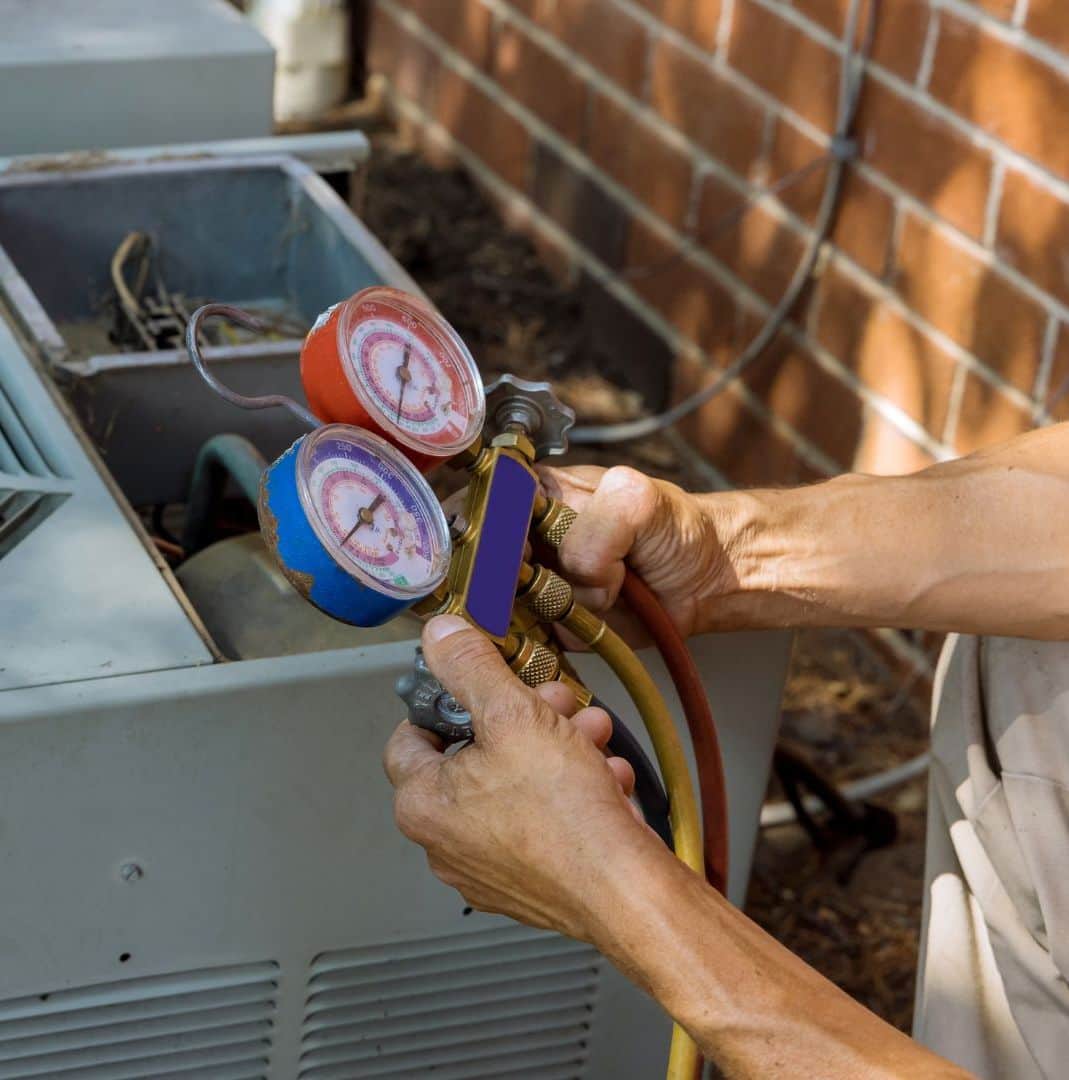
One of the best investments you can make is scheduling a pre-season checkup with your local HVAC professionals. A trained technician will uncover hidden performance issues, verify refrigerant levels, clean coils, and inspect all electrical components, ensuring your system runs at peak efficiency when the heat arrives.
Regular servicing also extends the life of your air conditioning system and prevents costly mid-summer breakdowns. Aim for at least one professional tune-up per year, ideally in spring and again in fall.
Contact us at Team Enoch to set up an appointment. We'll make sure your system is ready.
02 - CHANGE YOUR AIR FILTER REGULARLY
This is one of the most impactful things you can do, and the most commonly overlooked. A dirty or clogged air filter forces your AC to work significantly harder, driving up energy bills and reducing its lifespan.
✔ How often:
Replace disposable filters every 1–3 months, or clean permanent filters monthly during peak cooling season.
✔ What to look for: Hold the filter up to light, if you can't see through it, it's time for a new one.
✔ Pro tip: Upgrade to a MERV 11–13 filter for better air quality without significantly restricting airflow.
03 - CLEAN AROUND YOUR OUTDOOR UNIT
Your outdoor condenser unit needs free, unobstructed airflow to operate efficiently. Debris, overgrown shrubs, and accumulated dirt force the unit to work much harder than necessary.
✔ Every spring: Rake away leaves, cut back grass and weeds at least 2 feet around the unit.
✔ Monthly in summer: Quickly clear away any grass clippings, branches, or dirt from around the unit.
✔ Shade the condenser: Planting shrubs or installing a shade structure (while maintaining clearance) can improve efficiency by reducing the heat the unit must expel.
04 - UPGRADE INSULATION IN YOUR ATTIC & WALLS
Good insulation doesn't just keep you warm in winter, it's equally critical for keeping cool air in during summer. Deficient insulation means your AC is constantly fighting heat radiating in through your walls and ceiling.
✔ Attic first: Heat rises, so attic insulation delivers the fastest return. Aim for R-38 to R-60 depending on your climate zone.
✔ Walls second: Blown-in insulation can be added to existing walls without a full renovation.
05 - AIR SEAL YOUR HOME
Insulation and air sealing are two different things, and you need both. Air sealing stops conditioned air from leaking out through gaps around windows, doors, electrical outlets, plumbing penetrations, and attic hatches. Even a well-insulated home can lose enormous amounts of energy through these hidden air leaks.
✔ DIY fixes: Use weatherstripping on doors, caulk around window frames, and foam sealant around pipe penetrations.
✔ Professional option: A blower door test performed by a certified energy auditor will pinpoint every air leak in your home, often finding surprising sources of loss you'd never notice on your own.
💡 Air sealing combined with insulation is consistently one of the highest-return improvements a homeowner can make before any equipment upgrade.
06 - SEAL & INSULATE YOUR DUCTWORK
Leaky ducts are a silent energy killer. According to the U.S. Department of Energy, duct air leakage can account for up to 40% of your heating and cooling energy loss. Properly sealing ducts can reduce those losses to less than 5%.
✔ For exposed ducts: In garages, basements, crawlspaces, and attics, insulate with R-6 minimum and seal all joints with mastic sealant (not standard duct tape, which degrades over time).
✔ For hidden ducts: Have a professional perform a duct blaster test to identify and seal leaks inside walls and ceilings.
✔ ROI: Duct sealing often improves system efficiency by 20–30%, one of the best returns available without replacing equipment.
07 - INSTALL CEILING FANS
Ceiling fans make you feel cooler even when the actual temperature is unchanged, this means you can raise your thermostat by 4°F without any loss of comfort, directly reducing your AC's workload.
✔ Direction matters: In summer, set your ceiling fan to rotate counterclockwise (when viewed from below) to push cool air down.
✔ Turn them off: Fans cool people, not rooms. Turn fans off when you leave a room to avoid wasting energy.
Team Enoch can help you install ceiling fans anywhere in your home, including rooms that require new wiring. Contact us for a free quote.
08 - KEEP INDOOR VENTS CLEAR & CLEAN
Your HVAC vents are the delivery system for all the cool air your system works hard to produce. Blocked or dirty vents waste that energy and can create pressure imbalances that damage your ductwork over time.
✔ Walk your home: Check all supply and return vents, make sure no furniture, rugs, toys, or boxes are blocking them.
✔ Vacuum regularly: Dust vent covers every few weeks and vacuum the opening to maintain unrestricted airflow.
✔ Professional duct cleaning: Consider having ducts professionally cleaned every 3–5 years, especially if you have pets or allergies.
09 - INSTALL A SMART THERMOSTAT
A smart thermostat is one of the best value-for-money upgrades available, typically delivering 10–15% savings on annual cooling and heating costs.
✔ Scheduling: Program temperature setbacks automatically, no more cooling an empty house.
✔ Geofencing: Modern smart thermostats detect when you've left home using your phone's GPS and adjust the temperature automatically, then start cooling again as you head back.
✔ Learning algorithms: Models like Nest and Ecobee learn your preferences over time and self-optimize without any manual programming.
✔ Remote control: Adjust your home's temperature from anywhere using your smartphone.
✔ Placement matters: Keep your thermostat away from lamps, appliances, sunny windows, or vents, a misread temperature means wasted energy.
10 - CONTROL INDOOR HUMIDITY
High humidity makes your home feel much hotter than the actual temperature, causing you to lower the thermostat and run your AC harder than necessary. Managing humidity is a completely separate lever from temperature, and it's one many homeowners ignore.
✔ Target range: Keep relative humidity between 40–60% in summer for maximum comfort at a higher thermostat setting.
✔ Standalone dehumidifier: A portable or whole-home dehumidifier in humid climates significantly reduces the load on your AC. ENERGY STAR certified models use 20% less energy than standard units.
✔ AC fan mode: Set your AC fan to AUTO (not ON), running the fan continuously re-evaporates collected moisture back into the air, increasing humidity and making your AC work harder.
💡 In humid climates, lowering humidity from 70% to 50% can feel like a 4–6°F temperature drop, letting you raise the thermostat without any loss of comfort.
11 - CLOSE CURTAINS & BLINDS DURING THE DAY
Solar heat gain through windows is one of the biggest contributors to indoor heat buildup during summer. South- and west-facing windows are the worst offenders in the afternoon.
✔ Thermal curtains: Heavy, lined curtains block significantly more heat than standard ones and cost very little.
✔ Reflective window film: An affordable DIY upgrade that reflects solar radiation before it enters the room.
✔ Double-pane windows: If upgrading windows, choose double-pane low-E glass, it reduces solar heat gain by up to 30% compared to single-pane glass while also improving insulation.
12 - SWITCH TO LED BULBS
Incandescent bulbs convert only about 10% of their energy into light, the rest becomes heat, adding unnecessary load to your air conditioner. LED bulbs produce the same light while generating up to 80% less heat and using a fraction of the electricity.
✔ Quick wins: Replace the bulbs you use most often first, kitchen, living room, and office lights have the biggest impact.
13 - AVOID HEAT-PRODUCING APPLIANCES DURING PEAK HOURS
Ovens, dryers, and dishwashers generate significant heat that your AC must then work to remove. On hot days, every BTU they produce translates directly into higher cooling costs.
✔ Shift to evenings: Run the dishwasher, dryer, and oven after 8 PM when outside temperatures have dropped.
✔ Dryer in particular: A running dryer draws warm air into your home from outside. Running it at night reduces this effect dramatically.
✔ Air fryer & microwave: Use these instead of the oven during summer, they produce a fraction of the heat.
14 - CLEAR YOUR AC DRAIN LINE
The condensate drain line near your indoor cooling coil can become clogged with algae, mold, or debris, causing water backups, damage, and reduced efficiency. This simple maintenance task takes under five minutes and can prevent expensive water damage.
✔ How to do it: Pour one cup of white vinegar or diluted bleach down the drain line, then flush with a gallon of water. Do this once a month during peak cooling season.
✔ Signs of a clog: Standing water around the indoor unit, musty odors, or the AC shutting off unexpectedly (safety float switches are triggered by overflow).
15 - CONSIDER AN HVAC ZONING SYSTEM
HVAC zoning divides your home into independent temperature-controlled areas, so you're only cooling the rooms you're actually using, not the entire house at once. For homes where certain rooms run significantly hotter or colder, zoning is one of the most efficient upgrades available.
✔ How it works: Motorized dampers in your ductwork open and close based on each zone's thermostat, no wasted cooling in empty bedrooms.
✔ Ductless mini-splits: For targeted room-by-room control without major ductwork, ductless mini-split systems are the most efficient option, achieving SEER2 ratings of 25+ and eliminating duct energy losses entirely.
BONUS TIP: UPGRADE YOUR EQUIPMENT
The U.S. Department of Energy estimates that replacing an older, inefficient air conditioner with a modern high-efficiency unit can save homeowners at least 20% on annual cooling costs. But the technology available today is dramatically more advanced than what was on the market even 5 years ago.
What to Know for 2025–2026:
✔ SEER2 Ratings: The industry now uses SEER2, a more accurate real-world efficiency standard. Minimum SEER2 is 13.4–14.3 depending on your region. The best systems today reach 26+ SEER2 for central AC and 30+ SEER2 for mini-splits.
✔ Variable-Speed / Inverter Technology: Variable-speed compressors modulate output from 20–100% of capacity, reducing energy consumption by 30–50% compared to older single-speed units. They also provide superior humidity control and much quieter operation.
✔ New Refrigerants (A2L): As of January 1, 2025, all new AC units and heat pumps must use A2L refrigerants (R-32 or R-454B) instead of R-410A, per EPA regulations. These are more environmentally friendly and come with improved efficiency. Note: R-410A systems cannot be retrofitted, replacement requires a full new unit.
✔ Consider a Heat Pump: Modern heat pumps provide both cooling AND heating at 200–400% efficiency, making them the most cost-effective all-in-one solution in most U.S. climates. 2025–2026 models operate efficiently down to -10°F.
✔ Ductless Mini-Splits: For additions, sunrooms, or homes without ductwork, mini-splits are the efficiency leaders, SEER2 ratings up to 30+ with no duct losses.
💡 Federal Tax Credits (2025): Under current legislation, homeowners can claim a 30% federal tax credit (up to $2,000) on qualifying heat pump installations, and up to $600 on high-efficiency central AC replacements. Check EnergyStar.gov for current eligibility.
The Little Things Add Up
Give some of these tips a try this summer. Small changes, taken together, can make a dramatic difference in the energy you use for cooling, and you'll enjoy a home that's more comfortable all season long. Whether it's a simple filter change this weekend or a full heat pump upgrade this spring, every improvement pays you back in lower bills and a longer-lasting system.
If you're considering any upgrade, from a smart thermostat to a full system replacement, contact us at Team Enoch. Estimates are always free, and our team is here to help you find the most efficient solution for your home and budget.
FAQ Videos

Is your home ready to face the chill? Trey from Team Enoch is here to guide you through the must-do winter prep for your plumbing.
Read More
Good, better, best. Goodman vs. Carrier vs. Traine. And, what is a variable speed system?
Read More
It doesn't need a tune up! Does your system need a tune up or full replacement?
Read More
Do you know what's supposed to be in an AC quote? Most people don't, and that's how they get charged for things later.
Read More
Here's the $5,000 rule we use for every call.
Read More
AC For $8,180. That's everything. Here's exactly what's in a real AC install quote no hidden fees.
Read More
How much does AC replacement actually cost in DFW? Don't have time? Get your estimate online!
Read More
Do you know what's in your AC quote?
Read More