Logo

Sign up to our newsletter and get all of the latest news and updates.

Contact Us

mail@teamenoch.com(407) 336-8000100 E Pine St STE 110Orlando, Florida 32801

Quick Links

About UsMembershipsFinancingBlogsPrivacy Policy

Services

HeatingAir ConditioningCommercial Services
bbbnate
bbb
nate

License #CAC1824490

Everything You Need to Know About Heating & Cooling Costs, Efficiency, and Incentives

Choosing between gas and electric HVAC isn't just about comfort, it's about money, energy bills, and making a decision you'll live with for 15-20 years. If you're here, you're probably asking yourself:

"Is gas HVAC better than electric? Why is my electric bill so high if I have gas heat? And what's changing in 2026?"

The good news? You're asking the right questions. The 2026 heating and cooling landscape looks different than it did even two years ago, with federal incentives shifting, energy prices changing, and new technology making electric systems more efficient than ever. Let's break it all down in plain English.

Is Gas HVAC Better Than Electric?

Here's the honest answer:

It depends on where you live, what fuel costs in your area, and what you're trying to optimize for.

In 2026, natural gas heating is generally 30-50% cheaper to run than electric resistance heating. However, modern heat pumps (which are electric) have changed the game, they can be 300-400% efficient because they move heat instead of creating it from scratch.

The Real-World Breakdown

  1. Gas furnaces: Fast, powerful heat that works in extreme cold. Monthly heating costs typically $30-60 for natural gas.
  2. Electric furnaces: Simpler installation, no gas lines needed, but higher operating costs at $130-180 per month.
  3. Heat pumps (electric): The new champion. Operating costs of $40-160 per month, plus they handle both heating AND cooling.

Why Is My Electric Bill So High with Gas Heat?

This is THE question that confuses most homeowners. You have a gas furnace, so why is your electric bill through the roof in winter?

The Hidden Electricity User: Your Blower Fan

Here's what most people don't realize: Your gas furnace burns natural gas to create heat, but it uses electricity to distribute that heat throughout your home.

Your furnace blower motor can use 300-500 watts per hour continuously.

When your furnace runs all winter, that blower is constantly pushing warm air through your ducts. A typical blower motor draws 7-15 amps and can add $15-50 per month to your electric bill. If you have an older single-speed motor, you're looking at the higher end of that range.

Other Electric Components in Gas Furnaces

  1. Ignitor: Uses 3-5 amps during startup
  2. Draft inducer fan: Clears exhaust gases
  3. Thermostat and control board: Minimal but constant draw
  4. Safety sensors: Always monitoring

In the Midwest, electricity spent on heating (13.9%) is almost identical to air conditioning (14.5%). Your gas furnace isn't as "gas only" as you thought.

How Much Does It Actually Cost to Run Each System in 2026?

Let's talk real numbers. Understanding total operating costs is crucial because your upfront savings can disappear quickly if you're paying more every month.

Monthly Heating Costs (Average Home)

  1. Natural gas furnace: $30-60 per month
  2. Propane furnace: $90-200 per month (highly variable)
  3. Electric resistance furnace: $130-180 per month
  4. Modern heat pump: $40-160 per month

Installation Costs

  1. Electric furnace: $1,000-4,000 (lower upfront cost)
  2. Gas furnace: $3,000-7,500 (higher due to gas lines and venting)
  3. Heat pump: $3,500-7,500+ (but handles both heating and cooling)

Pro tip: Don't just look at installation costs. A system that costs $2,000 less to install but costs $50 more per month to run will cost you more after just 3.5 years.

Should I Switch from Gas to Electric Heating in 2026?

The big question everyone's asking. Here's what's changed:

When Switching Makes Sense

  1. You live in a moderate climate (rarely below 20°F)
  2. Your current system is 15+ years old and needs replacement anyway
  3. You're in a state with strong rebate programs (more on this below)
  4. You want both heating AND cooling in one efficient system
  5. Electricity rates in your area are competitive with natural gas

When to Stick with Gas

  1. You live in very cold climates (consistently below 0°F)
  2. Natural gas is cheap in your area and electricity is expensive
  3. Your gas furnace is less than 10 years old and running well
  4. You have a large home that needs powerful, fast heating

The $5000 Rule for HVAC - What You Should Know

You might have heard about the "$5000 rule" for HVAC systems. Here's what it actually means:

This is an old industry guideline that suggests: If your repair cost multiplied by the age of your system equals $5,000 or more, it's time to replace rather than repair.

Example: Your 12-year-old furnace needs a $500 repair. 12 × $500 = $6,000. Time to replace.

But here's the reality in 2026: This rule is outdated. Modern high-efficiency systems can last 20-30 years, and with the new incentive landscape, you should consider:

  • The efficiency of your current system
  • Available rebates and incentives
  • Your monthly energy costs
  • Whether you need both heating and cooling

2026 HVAC Incentives: What's Changed and What's Still Available

The incentive landscape has shifted dramatically in 2026.

Federal Tax Credits - What's Ending

The federal Energy Efficient Home Improvement Credit (25C) that offered 30% tax credits with a $2,000 cap for heat pumps expired on December 31, 2025. If you purchased and installed a qualifying system in 2025, you can still claim it on your 2026 taxes, but new installations in 2026 do not qualify for this federal credit.

State Rebate Programs - What's NEW

The good news? Two major rebate programs funded by the Inflation Reduction Act are rolling out through state programs throughout 2026:

1. HOMES (Home Energy Performance-Based Program)

•        Rewards whole-home efficiency improvements

•        Available to all income levels

•        Rebate amounts DOUBLE for low-moderate income households

2. HEAR (Home Electrification and Appliance Rebates)

•        Up to $8,000 for heat pumps

•        $14,000 maximum per household for all efficiency upgrades

•        Primarily for low-moderate income households (under 80-150% area median income)

•        Point-of-sale rebates (instant discount, not waiting for tax time)

Important: These programs are administered by individual states, so availability, amounts, and qualification requirements vary. Some states (like California) are already fully reserved in certain regions. Check your state energy office website for current status.

Utility Rebates - Still Going Strong

Many utility companies continue offering their own rebate programs for high-efficiency HVAC systems. These can be combined with state programs in some cases. Check with your local utility provider.

Gas vs Electric: Efficiency Comparison

Let's talk about how efficiently each system actually works:

Gas Furnace Efficiency

•        Standard gas furnaces: 80% AFUE (Annual Fuel Utilization Efficiency)

•        High-efficiency gas furnaces: 90-98% AFUE

•        Typical lifespan: 15-20 years

Electric System Efficiency

•        Electric resistance furnaces: Nearly 100% efficient (but electricity costs more)

•        Modern heat pumps: 300-400% efficient (SEER2 16+)

•        Typical lifespan: 20-30 years

The game-changer: Heat pumps can be MORE than 100% efficient because they move heat rather than creating it. For every 1 unit of electricity used, they can deliver 3-4 units of heat.

Maintenance and Long-Term Costs

Gas Furnace Maintenance

  • Annual professional inspection required (safety critical)
  • Burner cleaning and inspection
  • Carbon monoxide detector required
  • More components that can fail
  • Typical annual maintenance cost: $100-200

Electric System Maintenance

  • Simpler design = fewer repairs
  • No combustion = safer operation
  • Filter changes are main maintenance
  • Typical annual maintenance cost: $50-100

How to Keep Your Heating Bills Down (Gas or Electric)

Regardless of which system you choose, these strategies can cut your heating costs by 20-40%:

The Big Money-Savers

  • Professional air sealing: Reduces heating costs by 15-20%
  • Add insulation: Pays for itself in 3-5 years
  • Seal your ductwork: Improves efficiency by 10-20%
  • Upgrade to a programmable thermostat: Each degree adjustment saves 1-3% on heating

For Gas Furnaces Specifically

  1. Check your blower fan setting: Set to "Auto" not "On" to save $15-50/month in electricity
  2. Consider upgrading to a variable-speed blower: Uses 75 watts vs 400 watts for older models
  3. Clean filters monthly: Dirty filters force your system to work harder

Simple Habits That Add Up

  • Lower thermostat by 7-10°F for 8 hours daily (saves 10% annually)
  • Close curtains at night to prevent heat loss
  • Use ceiling fans in reverse (clockwise) to push warm air down
  • Keep vents clear and unblocked

Most Efficient HVAC System for Homes in 2026

Based on 2026 technology and energy costs, here's the ranking:

#1: Modern Inverter Heat Pump (SEER2 16+)

  • Best overall efficiency (300-400%)
  • Handles both heating and cooling
  • Works well in all but extreme cold
  • Eligible for state rebates in most areas
  • Operating cost: $40-160/month

#2: High-Efficiency Gas Furnace (90-98% AFUE)

  • Great for very cold climates
  • Lowest monthly operating costs
  • Fast, powerful heating
  • Requires natural gas availability
  • Operating cost: $30-60/month

#3: Dual-Fuel System (Heat Pump + Gas Backup)

  • Best of both worlds
  • Heat pump for moderate temps
  • Gas kicks in for extreme cold
  • Highest upfront cost but great efficiency

Real Talk: What Are the Disadvantages?

Gas Furnace Downsides

  • Produces carbon monoxide (requires monitoring)
  • Requires annual safety inspections
  • More complex system = more potential failures
  • Shorter lifespan (15-20 years)
  • Gas prices can fluctuate
  • Not available in all areas

Electric Furnace Downsides

  • High operating costs (for resistance heating)
  • Slower heating compared to gas
  • Large electrical demand
  • May require electrical panel upgrade

Heat Pump Disadvantages

  • Reduced efficiency in extreme cold (below 0°F)
  • Higher upfront cost
  • More frequent maintenance needed
  • May need backup heat source in very cold climates

Bottom Line: Which System Should You Choose?

Here's your decision framework based on real-world factors:

Choose a Modern Heat Pump if:

  • You live where winter temps rarely drop below 20°F
  • You want one system for heating AND cooling
  • You qualify for state rebate programs
  • You want the most energy-efficient option
  • Electricity costs in your area are reasonable

Choose a High-Efficiency Gas Furnace if:

  • You live in a very cold climate (consistently below 0°F)
  • Natural gas is available and cheap in your area
  • You have a large home that needs powerful heating
  • Your current gas system is in place (no need for new lines)
  • You prioritize low monthly operating costs

Consider a Dual-Fuel System if:

  • You experience variable winters (some mild, some extreme)
  • You want maximum efficiency and reliability
  • You can handle higher upfront costs
  • You want the best of both technologies

Action Steps: What to Do Next

1. Check Your State's Rebate Program Status

Visit your state energy office website to see if HOMES and HEAR programs are accepting applications. Some states have waitlists.

2. Calculate Your Actual Costs

Look at your utility bills for the past year. Calculate what you're REALLY paying for heating (including that blower motor electricity!).

3. Get Multiple Quotes

Get at least 3 quotes from certified HVAC contractors. Ask specifically about:

  • System efficiency ratings (AFUE or SEER2)
  • Estimated monthly operating costs
  • Available rebates and how to apply
  • Installation timeline

4. Consider Timing

Off-season (spring/fall) often has better pricing and faster installation. However, if rebate programs are filling up, don't wait too long.

5. Think Long-Term

Don't just look at sticker price. Calculate total cost of ownership over 15-20 years including:

  • Installation costs
  • Monthly operating costs
  • Maintenance and repairs
  • Rebates and incentives
  • Expected lifespan

The choice between gas and electric HVAC isn't as simple as "one is always better." In 2026, the answer depends on your climate, energy costs, available rebates, and what you prioritize.

What HAS changed is that modern heat pumps are no longer just a California thing. They work efficiently in most climates and, with the new state rebate programs, can be surprisingly affordable upfront.

The most important thing?

Stop looking at just the installation cost. A system that costs $2,000 less to install but costs you $600 more per year to operate is NOT a good deal.

Do your homework, run the numbers for YOUR situation, and make the choice that will keep you comfortable and save you money for the next 15-20 years.

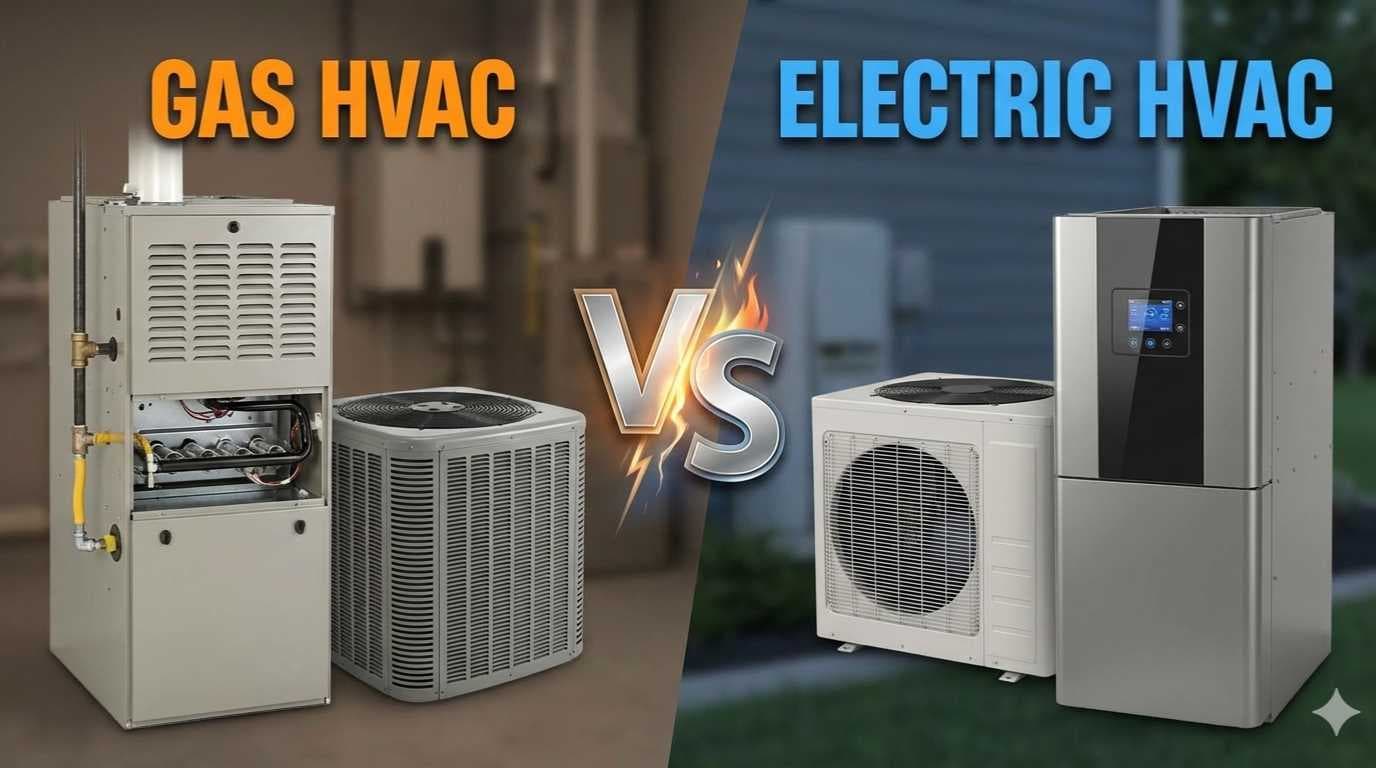
Gas vs Electric HVAC The Complete Detailed Comparison

Gas vs Electric HVAC: The Complete Detailed Comparison

Compare Gas vs Electric HVAC systems with our complete guide. Learn about efficiency, costs, performance, and maintenance to find the best heating and cooling solution for your home.

Team Enoch

February 11, 2026

Talk To Our Orlando HVAC Experts

Fill out this form to receive a call from one of our experts or call us directly at (407) 336-8000

Talk To Our Orlando HVAC Experts

Fill out this form to receive a call from one of our experts or call us directly at (407) 336-8000

Logo

Services

Service Areas

Financing

Memberships

Company

Get a Quote

Logo