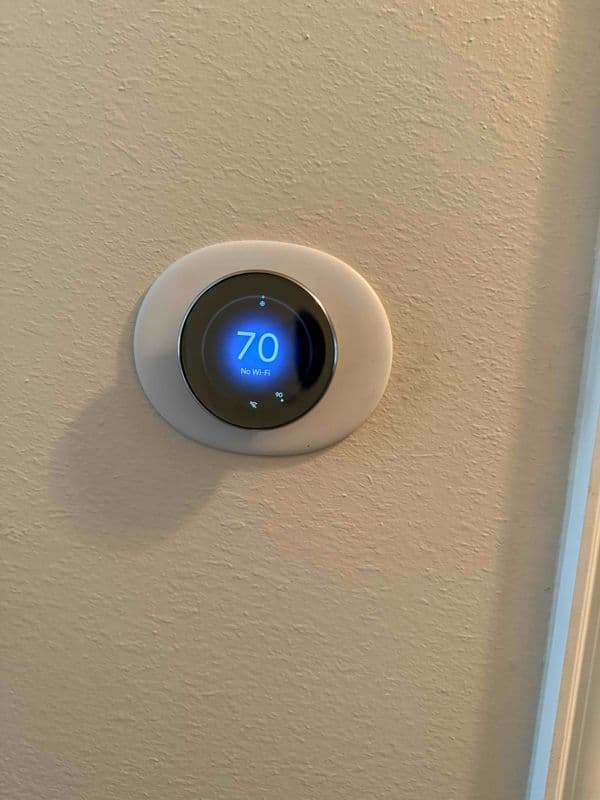
Why Your AC Is Set to 72 but Still Feels Like 78, And How to Fix It
Team Enoch
March 23, 2026
You walk over to the thermostat. It clearly says 72°F. You've had it set there for hours. But the room still feels warm, sticky, and nothing like 72. You're not imagining it. And you're not alone, this is one of the most-searched HVAC complaints every summer, and it spikes dramatically in Texas between June and September.
The frustrating part? There's no single answer. The gap between what your thermostat says and what your body actually feels can be caused by at least eight different problems, some of which you can fix yourself in ten minutes, and some of which require a licensed technician. This guide walks you through every one of them, in the order you should check them.
Here's the thing most people miss: your thermostat is reading the air temperature near where it's mounted. Your body is doing something completely different. It's responding to air temperature plus humidity, plus radiant heat from walls and ceilings, plus airflow. That combination is called perceived temperature, and it can make a 72°F room feel like 78°F or worse, entirely because of factors your thermostat can't measure.
Let's break every one of them down.
This is the most overlooked cause of the problem, and in Texas it's almost always part of the equation.
When relative humidity is high, evaporation from skin slows, fabrics feel clammy, and you perceive temperatures several degrees warmer than what the thermostat is reading. That "sticky" sensation is a human response to moisture, not a thermostat error. The same principle behind the outdoor "heat index", the "feels like" temperature on weather apps, applies inside your home too.
Your air conditioner doesn't just cool your air. It dehumidifies it. As warm, moist return air passes over the system's cold evaporator coils, water vapor condenses on the coil and drains away, reducing humidity. Cooler air can hold less moisture, so when your AC runs long enough, it not only cools the air but also extracts significant moisture.
The problem is, several things can prevent this dehumidification from happening properly. An oversized system that short-cycles never runs long enough to wring out the moisture. A system with low refrigerant can't get the coil cold enough to condense humidity efficiently. Dirty coils, clogged drain lines, and leaky ductwork all make the problem worse.
The fix: Your indoor relative humidity during summer should stay between 40–55%. If you don't have a hygrometer (a small device that measures humidity, available for under $20), buy one and check your readings. If you're consistently above 60% indoors, your system isn't dehumidifying properly, and the humidity gap is making your home feel far warmer than the thermostat shows. A whole-home dehumidifier or a variable-speed system that modulates airflow to increase coil contact time can both solve this problem permanently.
Also check your fan setting: setting the fan to "On" instead of "Auto" causes humid air to be blown back into the room even when the cooling cycle is not running, which actively fights your system's ability to dehumidify. Switch it to "Auto."
This one causes a surprising amount of confusion because it's completely invisible to the homeowner.
Your thermostat measures the air temperature at one specific point on one wall in your home. If that location is receiving any source of additional heat, direct sunlight through a window, radiant heat from a lamp or appliance, warmth from the kitchen, or even the body heat of people walking past frequently, the extra warmth in that area may trick the temperature sensor into thinking the home is warmer overall than it actually is. That means your thermostat can't accurately sense general indoor temperatures.
In practical terms, this means your thermostat might be reading 72°F because it's in a cooler hallway while the rest of your living space, where you actually spend time, is sitting at 76°F or higher. The thermostat is satisfied. You are not.
The correct thermostat location is an interior wall, roughly five feet from the floor, away from windows, exterior walls, vents, and any heat-generating appliances. It should be in a room that represents the average temperature of the spaces you occupy most.
The fix: If you suspect your thermostat is poorly placed, you can verify it easily. Set it to a temperature, wait for the AC to satisfy, and then measure the actual temperature in your main living areas with a separate thermometer. If there's a consistent gap of more than 2°F, thermostat placement is almost certainly part of your problem. A Team Enoch technician can relocate it, this is typically a low-cost fix that can make an immediate and noticeable difference in comfort.
This is one of the most common causes of a system that runs constantly but never quite gets there, and it's one that requires professional attention.
HVAC units rely on refrigerant to bring down the temperature of your home's air and to transfer heat back outside. If the refrigerant is leaking, the air isn't getting cooled down sufficiently, and heat transfer isn't happening efficiently. This can mean that your home feels warmer than usual, even when the AC unit is running.
If your refrigerant levels are even slightly low, your home may still produce cold air, but the system will use more electricity, remove less humidity, and overheat the compressor. Many homeowners live with a slow refrigerant leak for months without realizing it, the system is still cooling, just not as effectively as it should be, and the gap between setpoint and reality creeps wider as the leak progresses.
Unlike oil in a car engine, refrigerant doesn't get consumed. Unless there's a leak, it will remain at the same level. If your system is running constantly but temperature isn't dropping, a refrigerant leak might be the issue.
Warning signs to watch for: The air from your supply vents feels less cold than usual. Use an infrared thermometer to measure the temperature coming from your air vents, the supply vent air should be 14 to 20 degrees Fahrenheit cooler than the air around the return vents. If the supply air is less than 14°F cooler than the return air, it could be a sign of a refrigerant issue. Other signs include ice on the refrigerant lines or outdoor unit, a hissing sound near the outdoor unit, or a sweet chemical odor when the system runs.
The fix: Refrigerant issues are not DIY territory. By federal law, refrigerant must be handled by a certified technician. If you suspect a leak, the first step is a professional inspection and refrigerant charge verification. Note: simply adding more refrigerant to a leaking system is not a real fix, the leak itself needs to be identified and repaired first. Call Team Enoch and we'll identify and resolve the issue correctly.
The evaporator coil is the component inside your air handler that actually removes heat from your indoor air. When it gets dirty, which happens over months and years of normal operation, its ability to absorb heat drops significantly. A dirty coil can't absorb heat and humidity as effectively. Similarly, a clogged filter restricts airflow, reducing the system's overall efficiency.
A dirty coil can also lead to something worse: a frozen coil. When restricted airflow causes the coil surface to get too cold, the moisture it's collecting freezes into a layer of ice rather than draining away. A frozen coil sounds counterintuitive, the system is too cold, so why isn't the house cold?, but the ice actually insulates the coil from the air it's supposed to be cooling, dropping your system's effective cooling capacity dramatically.
If your air conditioner is taking a long time to cool your house or the airflow feels weak, and you notice ice building up on the outdoor unit or refrigerant lines, these are signs to call a professional. Continuing to run the system with a frozen coil may cause damage to the compressor.
There's also a more hidden coil problem worth knowing: chemical reactions between high humidity levels, volatile organic compounds (VOCs), and the copper piping of evaporator coils can produce formic acid that corrodes the copper, eventually causing small pinhole leaks. VOCs are present in many common household products, cleaning sprays, air fresheners, paint, flooring adhesives. Over years of exposure in a sealed home, this chemical reaction can quietly destroy a coil from the inside.
The fix: An annual AC tune-up, performed by a Team Enoch technician, should include cleaning the evaporator coil as a standard step. If you suspect your coil is frozen right now, turn the system off (switch to fan-only if your thermostat allows it), let it thaw for a few hours, check and replace the air filter, and then restart. If it freezes again, call us, the underlying cause is either restricted airflow or a refrigerant issue that won't resolve itself.
This sounds too simple to matter, but a severely restricted air filter is surprisingly effective at making your house feel warm even with the AC running.
Here's the chain of events: a clogged filter reduces the volume of air flowing across the evaporator coil. With less air contact, the coil gets too cold, starts building frost, and eventually loses its ability to cool effectively. Meanwhile, the rooms farthest from the air handler receive noticeably less airflow and feel warmer as a result.
The general guidance is to replace 1-inch filters every 30–90 days depending on pets, allergies, and household conditions. If you have pets or anyone in the home with respiratory sensitivities, 30-day changes are realistic. A filter that's been in place for six months isn't just restricting airflow, it's also doing a poor job of capturing dust, which means that dust is building up on your coil instead.
The quick check: Pull your filter and hold it up to a light source. If little to no light passes through, it needs to go. While you're there, check that the filter is the right size for the slot, a filter with gaps around the edges lets unfiltered air bypass it entirely and accelerates coil contamination.
Most Texas homes have ductwork running through attic space. That's significant because on a typical 90°F summer day, attic temperatures can climb between 130°F and 150°F, especially in poorly ventilated or under-insulated homes.
Now consider: if your duct connections are leaking, and in most homes, they are to some degree, a typical home loses 20–30% of its conditioned air before it can reach living areas. Air you paid to cool to 55°F is escaping into a space that's 140°F and never making it to the rooms where you need it. The rooms at the end of the duct runs, usually bedrooms and rooms farthest from the air handler, feel it the worst.
Duct leaks can also draw humid air from attics, crawl spaces, or outdoors into your system. This extra moisture circulates back into your living spaces, raising indoor humidity and compounding the comfort problem further.
Signs of duct leakage: Some rooms are consistently warmer than others regardless of how long the system runs. Your energy bills are higher than neighbors with similar homes. You notice dust around your supply registers even after you've changed the filter. A professional duct pressure test (sometimes called a duct blaster test) can quantify exactly how much air your duct system is losing and where.
The fix: Professional duct sealing using mastic compound or metal tape (not standard contractor's tape, which fails over time) at all duct connections and joints. In some cases, duct replacement makes more financial sense than extensive sealing, a Team Enoch technician can advise based on the age and condition of your system.
An AC unit can be too large for a space. An oversized unit will short-cycle, cool your home fast, then shut off, over and over again, and decline from overuse faster than an appropriately sized unit. Due to short cycling, an oversized unit will not run long enough to effectively remove humidity from indoor air. The higher humidity will make you feel hotter and more uncomfortable, leading you to crank the AC and your utility bill. It's a vicious cycle.
This is where the "feels like 78 even though it's set to 72" problem gets genuinely tricky, because the house is reaching 72°F at the thermostat briefly, then the system shuts off and the temperature starts climbing before humidity has been addressed. You feel warm not because the air temperature is wrong but because the air is damp.
An undersized system has the opposite problem: it runs continuously and still can't keep up when outdoor temperatures are at their peak. If your house requires a 3-ton AC unit but you have a 2-ton unit installed, it will not be able to cool the house to 72°F on a hot day. You might set the thermostat to 72°F but the temperature measured by a thermometer will be something like 76°F.
Both problems trace back to the same root cause: a system was selected without a proper Manual J load calculation, which is the only accurate method of determining what size system a specific home actually needs.
The fix: If your system is new and you're experiencing these symptoms, request a Manual J calculation review from Team Enoch. If your system is old and undersized, replacement with a properly sized variable-speed unit, which modulates its output rather than cycling on and off, will often solve both the temperature and humidity problem simultaneously.
This one is important to understand because it's not a malfunction, it's physics.
Air conditioning systems are designed to maintain a comfortable roughly 20-degree temperature difference between indoor and outdoor temperatures. So while you might have the AC set at 72°F, don't be surprised if the system can't cool your home below 75°F on the hottest days above 92°F. HVAC systems are sized according to a region's typical peak temperatures, not its absolute extremes.
On a 105°F day in Dallas or San Antonio, your system is working at its absolute design limit. If it's running continuously and maintaining 75–76°F indoors, that's actually the system doing its job correctly given the conditions. The problem isn't the equipment, it's the expectations set by a comfortable 85°F spring day when the system seemed to cool effortlessly.
That said, there's a meaningful difference between "struggling slightly on an extreme day" and "consistently failing by 5+ degrees throughout the season." If your system can't maintain a 20-degree indoor-to-outdoor differential on typical summer days, something else from this list is also in play.
Before calling a technician, run through these in order. Many homeowners find their answer in the first three steps.
Step 1 — Check your air filter. Pull it and look at it. If it's visibly gray and clogged, replace it and run the system for a few hours before judging anything else.
Step 2 — Check your fan setting. Make sure it's set to "Auto," not "On." The "On" setting runs the fan continuously even when the system isn't in a cooling cycle, which recirculates humidity.
Step 3 — Measure your indoor humidity. Pick up a hygrometer at any hardware store. If you're above 60% RH, humidity is making you feel warmer than the temperature reading suggests.
Step 4 — Check your supply vent airflow. Hold your hand near each register. Is airflow noticeably weak in some rooms? This points to duct issues or coil restriction.
Step 5 — Check for ice. Go to your outdoor unit and look at the large insulated copper pipe (the suction line) going into the unit. If it has frost or ice on it, your system has a problem, turn it off and call a technician.
Step 6 — Check the temperature differential. If you have a thermometer, measure the air at a return vent and then at a supply vent nearby. The supply air should be 14–20°F colder. A smaller gap than that means your system isn't removing heat effectively.
If all six checks look normal and your home still consistently feels warmer than the setpoint during typical (not extreme) summer days, the problem is most likely either refrigerant charge, duct leakage, or improper sizing, all of which require a professional evaluation from Team Enoch.
Is it normal for the AC to run all day in Texas summer? It's common, but "running all day" means different things depending on outside temperature. On a 100°F+ day, near-continuous operation is expected and normal, that's the system doing its job at full capacity. On a typical 90°F day, your system should cycle on and off in intervals, reaching your setpoint and maintaining it. If it runs non-stop on a typical day and never satisfies, one of the problems above is in play.
Why does my upstairs feel so much hotter than downstairs even with AC running? Heat rises, and your attic is directly above your upper floor, radiating significant heat downward through the ceiling. When your attic reaches temperatures over 130°F, that heat starts to affect the floors and ceilings directly beneath it. Bedrooms and upstairs hallways all begin to warm up, causing your air conditioning system to run longer and harder to keep the home cool. Inadequate attic insulation, duct leakage in the attic space, and insufficient airflow to second-floor rooms are the most common culprits.
Can a dirty condenser (outdoor unit) make my house feel warmer? Yes. The condenser coil on your outdoor unit releases the heat that was extracted from your home. If it's clogged with dirt, grass clippings, cottonwood, or pet hair, it can't release that heat efficiently, and your system's cooling capacity drops as a result. You can gently rinse the outdoor coil with a garden hose (spray from inside outward, not outside in) to remove surface debris. Deeper cleaning should be done by a Team Enoch technician.
Why does the air feel cold at the vent but the room still feels warm? Cold air coming from the vent is a good sign, it means the system is producing cold air. But if the room still feels warm, you're likely dealing with one of three scenarios: the volume of airflow is too low (too few or undersized ducts, closed dampers), the humidity in the room is too high for the air temperature to feel comfortable, or the room has a significant heat source (sun-facing windows, poor insulation, appliance heat) that's overwhelming the cooling supply.
How do I know if my AC refrigerant is low? The symptoms overlap with other problems, but the most reliable indicators are: the system runs longer than usual without satisfying, the air from vents is less cold than it used to be, ice appears on the outdoor unit or suction line, and your energy bills have increased without a change in usage patterns. A Team Enoch technician can verify the charge precisely with gauges in about 15 minutes.
Does a smart thermostat fix these problems? A smart thermostat can help manage temperature schedules and provide useful data about run times and performance, and can flag if your system is running unusually long. But it cannot fix a refrigerant leak, dirty coils, duct leakage, or improper sizing. Think of a smart thermostat as a dashboard that gives you better visibility, not a mechanic that fixes what's wrong under the hood.
You can confidently handle the following yourself: replacing the air filter, switching the fan to "Auto," rinsing the exterior of the outdoor unit with a hose, and buying a hygrometer to check humidity.
Everything else on this list, refrigerant charge and leaks, coil cleaning, duct testing and sealing, thermostat relocation, and any diagnosis involving ice, unusual sounds, or consistently poor cooling despite basic maintenance, requires a licensed HVAC technician with proper tools and certifications. That's where Team Enoch comes in.
In Texas, always confirm your contractor holds a current TACLB (Texas Air Conditioning Contractor License) number before scheduling any work. It's a quick search on the Texas Department of Licensing and Regulation website, and it ensures the person diagnosing your system is legally qualified to do so.
The stakes of this problem are higher here than in most of the country. In Texas, attic temperatures can soar above 150°F. For comparison, if the outside temperature is 95°F, a poorly insulated attic with no ventilation might be 50 to 60 degrees hotter than the outdoor air. That kind of heat buildup puts serious strain on your home's cooling system and energy consumption.
When your ducts are running through a space that hot, every degree of efficiency loss compounds faster than it would anywhere else in the country. A small refrigerant undercharge that barely shows up in spring becomes a serious comfort problem in July. Duct leakage that carries a moderate energy cost in a mild climate becomes extreme here, where duct runs pass through 140°F+ air for months at a time.
The practical implication: Get your system serviced in March or April, before the heat hits. A spring tune-up with Team Enoch that catches a slow refrigerant issue, cleans the evaporator coil, and verifies duct integrity in April costs a fraction of what an emergency summer call costs, and it means your system is performing correctly when it needs to perform the most.
The gap between "what the thermostat says" and "what your body feels" is almost never a mystery once you know what to look for. Work through the checklist above and you'll either find the answer yourself in a few minutes, or you'll walk into a conversation with Team Enoch knowing exactly what to ask about, which is a better starting point than most homeowners have.